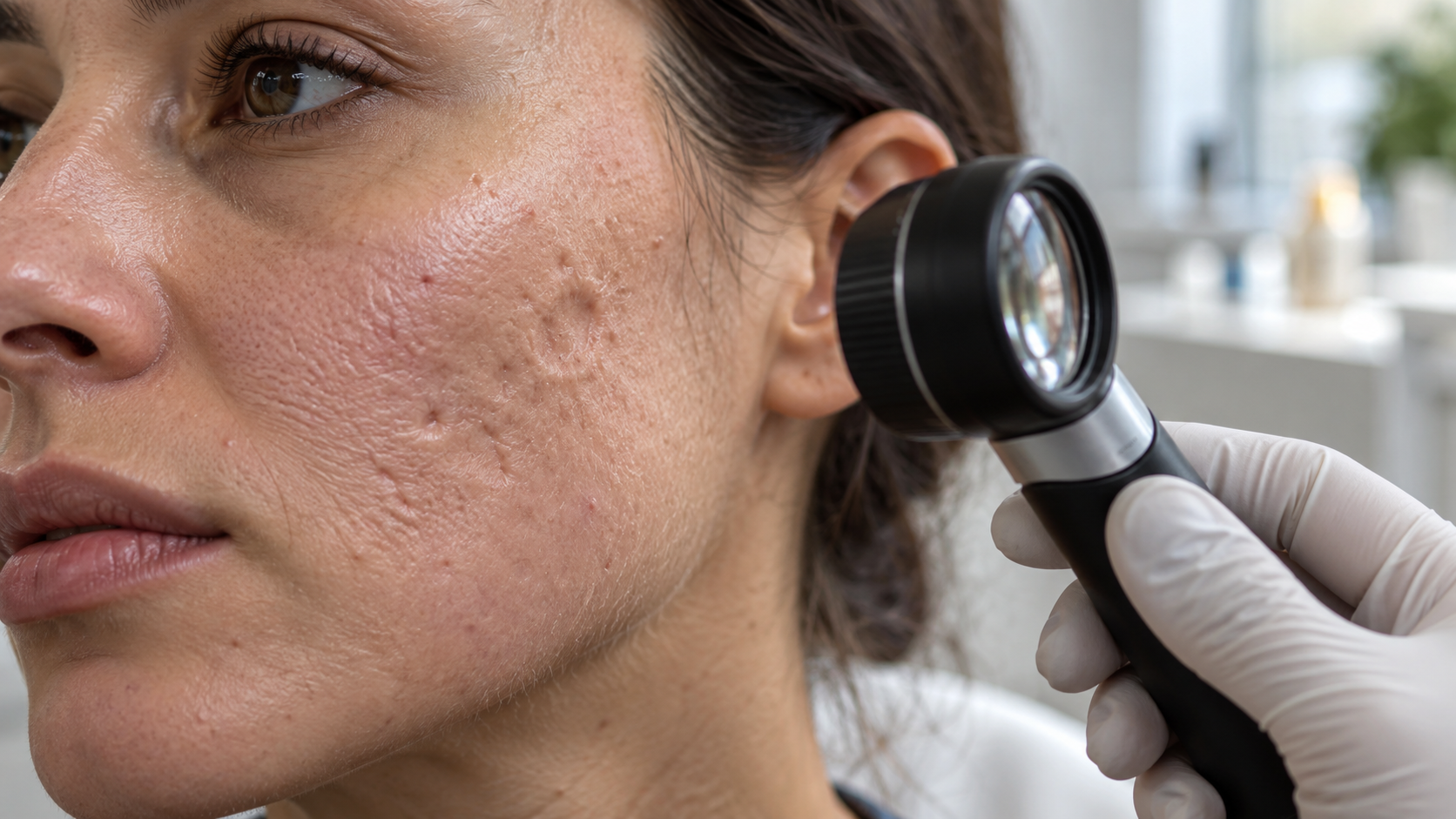
How do I know which type of acne scar I have?
Atrophic (indented) scars make up as much as 90 percent of all acne scarring, and they fall into three recognised shapes. A quick way to check at home is to stand near a window with light coming from the side. Shadows reveal depth and edges that overhead bathroom lighting hides.
Ice pick scars
Narrow pits, usually under 2 mm across, that look like the skin was punctured with a fine point. They extend deep into the dermis, which is why they are considered the hardest type to treat and why surface-only treatments tend to disappoint. They are also the most common atrophic scar, accounting for roughly 60 to 70 percent of cases.
Boxcar scars
Wider depressions, typically 1 to 4 mm across, with defined vertical edges and a flat base. Think U-shaped rather than V-shaped. Depth varies, and shallow boxcar scars respond better to resurfacing than deep ones.
Rolling scars
Broad, shallow dips with sloping edges that give the skin a wavy look, often across the cheeks. They form when fibrous bands tether the skin down to the deeper tissue, so the surface is pulled inward rather than removed.
Most people have more than one type on the same cheek. Dark or red marks left behind after a breakout are post-inflammatory pigmentation, not true scars, and they are treated differently.
Why don’t acne scars fade on their own?
A scar is a repair, not a wound that is still healing. Once the body has filled an acne lesion with disorganised collagen (or failed to fill it at all), that structure is stable and the skin has no reason to keep remodelling it. Topical products can improve the pigment and surface smoothness around a scar, but they cannot rebuild missing collagen at depth.
Atrophic scars can also become more noticeable with age, because the skin gradually loses collagen and elasticity, which makes any existing dip cast a bigger shadow. Cleveland Clinic notes that delays in treating acne itself increase the severity of scarring, and that active breakouts need to be settled before scar treatment begins, since acne medications and scar procedures can interfere with each other.
What is the best treatment for ice pick scars?
Because ice pick scars are so deep and narrow, the strongest evidence is for treatments that target each scar individually. In a 2020 review of scar treatment in Plastic and Aesthetic Research, punch excision (surgically removing the scar and closing it) and TCA CROSS (placing a high-strength trichloroacetic acid directly into the pit) were highlighted as the main options. Both are physician-level procedures rather than medical spa treatments.
For energy devices, the same review notes that results on ice pick scars are often less satisfying than on other types, with one exception: a study by Ramesh and colleagues found ice pick scars actually responded better than rolling or boxcar scars to fractional radiofrequency, the technology behind RF microneedling. That makes RF microneedling a reasonable first step for scattered ice pick scars when the goal is overall improvement rather than erasing a single pit.
What works for boxcar scars?
Boxcar scars sit in the middle of the difficulty range. The collagen loss is spread sideways rather than straight down, so resurfacing treatments that rebuild collagen across an area work well. The 2020 review cites a study by Sardana and colleagues in which boxcar scars improved by about 53 percent with a fractional non-ablative laser, compared with about 43 percent for rolling scars in the same trial.
In practice, shallow boxcar scars respond to a series of microneedling sessions, while deeper, sharp-edged boxcar scars are where fractional CO2 laser resurfacing or RF microneedling earns its downtime. Dermal filler can also lift an isolated deep boxcar scar temporarily, which Cleveland Clinic lists as an option for pitted atrophic scars.
How are rolling scars treated?
Rolling scars are tethered, so the ideal plan loosens the bands and then rebuilds collagen in the dip. Subcision, where a needle releases the fibrous bands beneath the scar, is the primary treatment described in the literature, often followed by a collagen-stimulating treatment such as microneedling or filler.
Where subcision is not needed or not wanted, rolling scars are the type most likely to improve with standard microneedling alone. A 2021 systematic review of nine randomised controlled trials in the Journal of Cosmetic Dermatology found microneedling effective for atrophic acne scars both on its own and in combination, with improvement visible after as few as three sessions.
Microneedling, RF microneedling or CO2 laser: which is right for acne scars?
These three sit on a spectrum of intensity, and the trade-off is between how much remodelling one session delivers and how much recovery it costs.
Standard microneedling (with a booster)
Fine needles create controlled micro-channels that trigger new collagen without removing any skin. Redness typically settles within 48 hours. It suits rolling scars, shallow boxcar scars, mixed mild-to-moderate scarring, and anyone with a deeper skin tone who wants to avoid the pigmentation risk of ablative lasers. Pairing it with a booster matters: a 2022 meta-analysis in Frontiers in Medicine found microneedling with PRP more effective than microneedling alone, and a 2025 meta-analysis of 566 patients found microneedling combined with a chemical peel outperformed either treatment on its own.
RF microneedling
The needles also deliver radiofrequency heat into the dermis, which tightens and remodels collagen more aggressively while leaving the surface mostly intact. In a 2023 randomised split-face trial published in Lasers in Surgery and Medicine, a single session of RF microneedling improved skin texture in acne scars to the same degree as a single session of fractional CO2 laser. It is the usual step up for deeper boxcar scars, scattered ice pick scars, and people who want laser-level results with less visible recovery.
Fractional CO2 laser
CO2 resurfacing vaporises microscopic columns of skin, which produces the most dramatic single-session remodelling of the three. A recent meta-analysis of randomised trials reported better scar improvement and patient satisfaction with fractional CO2 than with RF microneedling, but also significantly more pain, a longer period of redness and a markedly higher risk of post-inflammatory hyperpigmentation. It is best reserved for deeper, well-defined scars in lighter skin tones, usually in the cooler months when sun exposure is easier to avoid.
Does VAMP (PDRN) help with acne scars?
VAMP is a bio-revitalising serum that combines vitamins, amino acids and minerals with PDRN, a purified DNA fragment derived from salmon. Applied through the open channels of a microneedling treatment, PDRN is used for its effect on repair: published reviews describe it reducing inflammation and supporting collagen remodelling in the context of acne scar treatment, as well as speeding wound healing.
The evidence has limits, and they matter. The clinical studies on PDRN with microneedling to date are small and focused mostly on skin quality and pigmentation rather than scar depth, so it should be thought of as a healing and skin-quality booster layered onto microneedling, not as a scar-filling agent in its own right. The needling does the structural work. For people whose scars come with redness, sensitivity or slow healing, that combination is a sensible choice, and it is why microneedling with a VAMP booster is often suggested for acne scarring alongside the PRP option.
How many sessions and how long until results?
Scar remodelling is slow because collagen is slow. After each microneedling or RF session, the skin keeps building new collagen for roughly four to six weeks, so results stack over a series rather than appearing after one visit. A typical plan for acne scarring is three microneedling sessions spaced four to six weeks apart, with the most noticeable change usually seen after the second or third session. CO2 is often done as a single, more intensive treatment, with results continuing to develop for several months afterward.
Because scars are often mixed, many plans combine approaches: a chemical peel to improve surface tone, microneedling for rolling scars, and RF microneedling or CO2 for the deeper pits. Expect a realistic timeline of three to six months to judge the full result of any plan, and plan around sun exposure, since fresh collagen and healing skin darken easily. For a broader overview of causes and at-home care, see what causes acne scars and how to fix them.
Frequently asked questions
Can acne scars be removed completely?
Not usually. The goal of treatment is to make scars significantly less visible by rebuilding collagen and smoothing the surface. Shallow rolling and boxcar scars can improve a great deal; deep ice pick scars are the most resistant and may need individual procedures.
Which acne scar treatment is best for darker skin tones?
Microneedling and RF microneedling are generally preferred, because they leave the surface intact and carry a lower risk of post-inflammatory hyperpigmentation than ablative CO2 laser. A provider will review your skin type and history before recommending any energy-based treatment.
Do I need to clear my acne before treating scars?
Yes. Active breakouts should be controlled first, since treating scars over inflamed skin can worsen both the acne and the scarring, and some acne medications interfere with scar procedures.
Is RF microneedling better than regular microneedling for scars?
For deeper scars, the added radiofrequency heat produces more remodelling per session. For shallow rolling scars and general texture, standard microneedling with a booster is often enough and has less downtime. The right choice depends on scar depth, skin tone and how much recovery time you can accept. A fuller comparison is in RF microneedling vs regular microneedling.
Does microneedling for acne scars hurt?
A numbing cream is applied before treatment, and most people describe the sensation as a light scratching or vibration. The treatment itself takes under 30 minutes once the skin is numb.
How much does acne scar treatment cost in Canada?
Costs vary widely by treatment type and the number of sessions. In Canada, a single microneedling session typically runs in the low hundreds of dollars, RF microneedling and fractional laser sessions are generally higher, and CO2 resurfacing is usually the most expensive per treatment. A consultation in London, Ontario with a skin analysis is the only way to get an accurate plan and quote for your specific scars.
Sources
- Cleveland Clinic. Acne Scars: types, causes and treatment.
- Cleveland Clinic. Scars: types, treatment and why acne scars become more noticeable with age.
- Review on the treatment of scars. Plastic and Aesthetic Research, 2020.
- Microneedling in the treatment of atrophic scars: a systematic review of randomised controlled trials. Journal of Cosmetic Dermatology, 2021.
- Kang C, Lu D. Combined effect of microneedling and platelet-rich plasma for the treatment of acne scars: a meta-analysis. Frontiers in Medicine, 2022.
- Chemical peeling in combination with microneedling versus monotherapy in the treatment of acne scars: a systematic review and meta-analysis. Advances in Dermatology and Allergology, 2025.
- Hendel K, et al. Fractional CO2 laser versus microneedle radiofrequency for acne scars: a randomized, single treatment, split-face trial. Lasers in Surgery and Medicine, 2023.
- EMJ Dermatology. Fractional CO2 laser versus microneedling radiofrequency for post-acne scarring: a meta-analysis of RCTs.
- Polydeoxyribonucleotide in skincare and cosmetics: mechanisms, therapeutic applications, and advancements beyond wound healing and anti-aging.
This article was medically reviewed by Derek Truong, NP, Medical Director at Infinite Medical Spa in London, Ontario. It is for educational purposes only and does not replace a personal consultation. Individual results vary.