Is fall hair shedding normal?
Yes. The American Academy of Dermatology says it is normal to shed between 50 and 100 hairs a day. You never notice most of them.
Shedding also follows the seasons. A six-year study of 823 healthy women, published in Dermatology in 2009, found the highest share of resting (telogen) hairs in summer. Resting hairs fall out a few months later, which lines up with the extra hair so many people find on their brush in October and November.
Shedding can also spike after a stressful event. The AAD lists giving birth, losing 20 pounds or more, illness with a high fever, surgery and stopping birth control as common triggers. This kind of shedding usually stops on its own, and hair tends to regain its normal fullness within six to nine months.
How can you tell shedding from thinning?
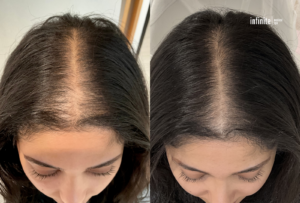
Shedding is about how many hairs fall out. Thinning is about what grows back. With shedding, new hairs replace the ones you lose. With thinning, the new hairs come in finer and shorter, or not at all, so the scalp slowly becomes easier to see.
Signs that point to thinning rather than a seasonal shed:
- Your part looks wider than it did a year ago.
- Your scalp shows through at the crown in bright light.
- Your ponytail feels smaller around.
- Your hairline or temples are slowly moving back.
- The change has lasted longer than six months.
Sudden bald patches, scalp pain, redness or scaling, or shedding that comes with fatigue or other symptoms are a reason to see your family doctor or a dermatologist first. Iron, thyroid function and hormones can all affect hair, and those need medical testing.
What is PRP hair treatment?
PRP stands for platelet-rich plasma. A small sample of your own blood is drawn and spun in a centrifuge, which separates out a layer packed with platelets. Platelets carry growth factors, proteins that signal cells to repair and grow.
That concentrated plasma is then injected into the thinning areas of the scalp. The goal is to support follicles that are still active but producing weaker hair, so they stay in the growth phase longer. Because PRP comes from your own blood, no outside product is involved.
A session takes about 45 to 60 minutes, including the blood draw and processing. At Infinite, every PRP hair plan is overseen by the Medical Director, and you can meet Derek Truong and the clinical team behind each treatment plan before you book.
Does PRP actually work for hair loss?
For the right person, the research is encouraging. A 2023 review in the Journal of Cutaneous Medicine and Surgery, a Canadian dermatology journal, pooled nine randomized trials with 238 patients who had pattern thinning. PRP increased hair density at both 3 and 6 months compared with a placebo.
A second 2023 review, in Aesthetic Plastic Surgery, found the same rise in density but no meaningful change in the thickness of each strand. So PRP tends to add more hairs per square centimetre rather than making the hairs you already have much thicker.
There are limits worth knowing. A 2024 review in Anais Brasileiros de Dermatologia found an average gain of about 27 hairs per square centimetre, but the studies varied a lot in how the PRP was prepared and injected, and the authors called for larger, better-designed trials. PRP has real evidence behind it. Results still differ from person to person, and no one can promise a specific outcome.
How many PRP sessions do you need, and when do you see results?
PRP works as a series. The International Society of Hair Restoration Surgery describes a common program as one session a month for three months, then a booster about every six months. At Infinite, an initial series usually runs 3 to 6 sessions spaced 4 to 6 weeks apart, depending on how much thinning there is and how your scalp responds.
A typical timeline:
- Month 1: shedding often slows first.
- Months 2 to 3: fine new hairs may start to show along the part or hairline.
- Months 3 to 6: most of the visible change in density shows up.
- 6 months and beyond: maintenance sessions every 6 to 12 months help hold results.
Hair grows slowly, which is why the studies above measured results at 3 and 6 months. Taking a photo in the same light once a month is the easiest way to track your progress.
Who is a good candidate for PRP?
PRP needs living follicles to work with, so timing is the biggest factor. It tends to suit:
- Early to moderate thinning, where hair is finer but still there.
- Women noticing a wider part or less volume at the crown.
- Men with a slowly receding hairline or thinning crown.
- People who want a non-surgical option, or extra support after a hair transplant.
It is a poor fit for areas that have been fully bald for years, since there may be no active follicles left. Blood disorders and blood-thinning medication can also rule PRP out, which is why a medical assessment comes first. And if your shedding is purely seasonal, the honest advice is often to wait it out and check again in the spring.
PRP vs microneedling for hair
Both aim to wake up tired follicles, but they get there differently. PRP delivers concentrated growth factors straight into the scalp. Microneedling creates tiny, controlled channels that trigger the skin’s own repair response.
The research in this article looks at PRP injections, which is how Infinite delivers PRP for hair. If you are weighing the two, read our breakdown of whether microneedling works for hair loss to see where it fits.
How much does PRP hair treatment cost in London, Ontario?
Price depends on the size of the area treated and how many sessions your plan needs. The International Society of Hair Restoration Surgery notes that PRP can cost as little as $400 or as much as $1,500 or more per session, based on US pricing. Canadian clinics that publish their prices, in cities like Toronto, Edmonton and Vancouver, generally list between about $350 and $1,200 per session.
Because PRP is a series, the cost of the full plan matters more than any single visit. Ask how many sessions you are likely to need, whether maintenance is part of the plan and who performs the injections. For a personal quote and a step-by-step look at the treatment, review PRP hair treatment at Infinite, including its cost FAQ. If you would rather spread the cost out, you can also check the financing options available at Infinite.
Infinite Medical Spa, London, Ontario
Shedding or thinning? Find out before you spend anything.
Every PRP hair plan at Infinite starts with a scalp assessment and a consultation with Derek Truong, NP, Medical Director. You leave knowing whether your hair change looks like a temporary shed or ongoing thinning, and whether a PRP plan makes sense for you, with no obligation to book treatment.
551 Oxford St W, Unit 201 · (519) 709-6494 · Mon to Sat, 8 to 4
Frequently asked questions
Does PRP for hair hurt?
Most people feel pressure and some stinging during the injections. Numbing is applied first, and the ISHRS notes that brief soreness at the injection sites is the main side effect.
Is there downtime after PRP hair treatment?
Very little. Mild tenderness, redness or swelling on the scalp usually settles within a day or two, and most people go back to work the same day. Your provider will tell you when you can wash your hair and work out again.
How long do PRP hair results last?
PRP does not switch off the process behind pattern thinning, so results fade without upkeep. Results from an initial series typically last 6 to 12 months, which is why maintenance sessions are part of most plans.
Is PRP for hair the same as PRP for the face?
The plasma is prepared the same way, but it is delivered differently. For hair, it is injected into the scalp. For skin, it is often paired with microneedling or injected to improve texture and tone. You can see how PRP and PRF injections are used for skin if you are curious about both.
Can PRP regrow hair on a completely bald spot?
Usually not. PRP supports follicles that are still active. Areas that have been smooth and bald for a long time often have no working follicles left, so other options are worth discussing at a consultation.
Should I start PRP while I am still shedding this fall?
If the shedding is seasonal or follows a clear trigger like childbirth, it often settles within a few months. An assessment helps sort out whether you are dealing with a temporary shed or ongoing thinning, and whether starting now makes sense.
Sources
- American Academy of Dermatology. Do you have hair loss or hair shedding?
- Canadian Dermatology Association. What is alopecia?
- Kunz M, Seifert B, Trüeb RM. Seasonality of hair shedding in healthy women complaining of hair loss. Dermatology, 2009.
- Platelet-rich plasma for androgenetic alopecia: a systematic review and meta-analysis of randomized controlled trials. Journal of Cutaneous Medicine and Surgery, 2023.
- Li M, et al. Effectiveness of platelet-rich plasma in the treatment of androgenic alopecia: a meta-analysis. Aesthetic Plastic Surgery, 2023.
- Kieling L, et al. Is autologous platelet-rich plasma capable of increasing hair density in patients with androgenic alopecia? Anais Brasileiros de Dermatologia, 2024.
- International Society of Hair Restoration Surgery. Platelet-rich plasma (PRP).
This article was medically reviewed by Derek Truong, NP, Medical Director at Infinite Medical Spa in London, Ontario. It is for general education only and is not a substitute for a personal medical assessment. Results vary from person to person.