
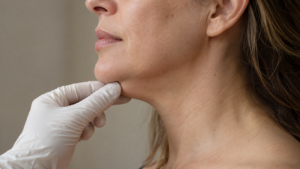
Double Chin Removal in London, Ontario: Fat or Loose Skin?
Double Chin Removal in London, Ontario: Is It Fat, Loose Skin or Your Jawline? Medically reviewed by Derek Truong, NP, Medical Director at Infinite Medical
Medically reviewed by Derek Truong, NP, Medical Director at Infinite Medical Spa.
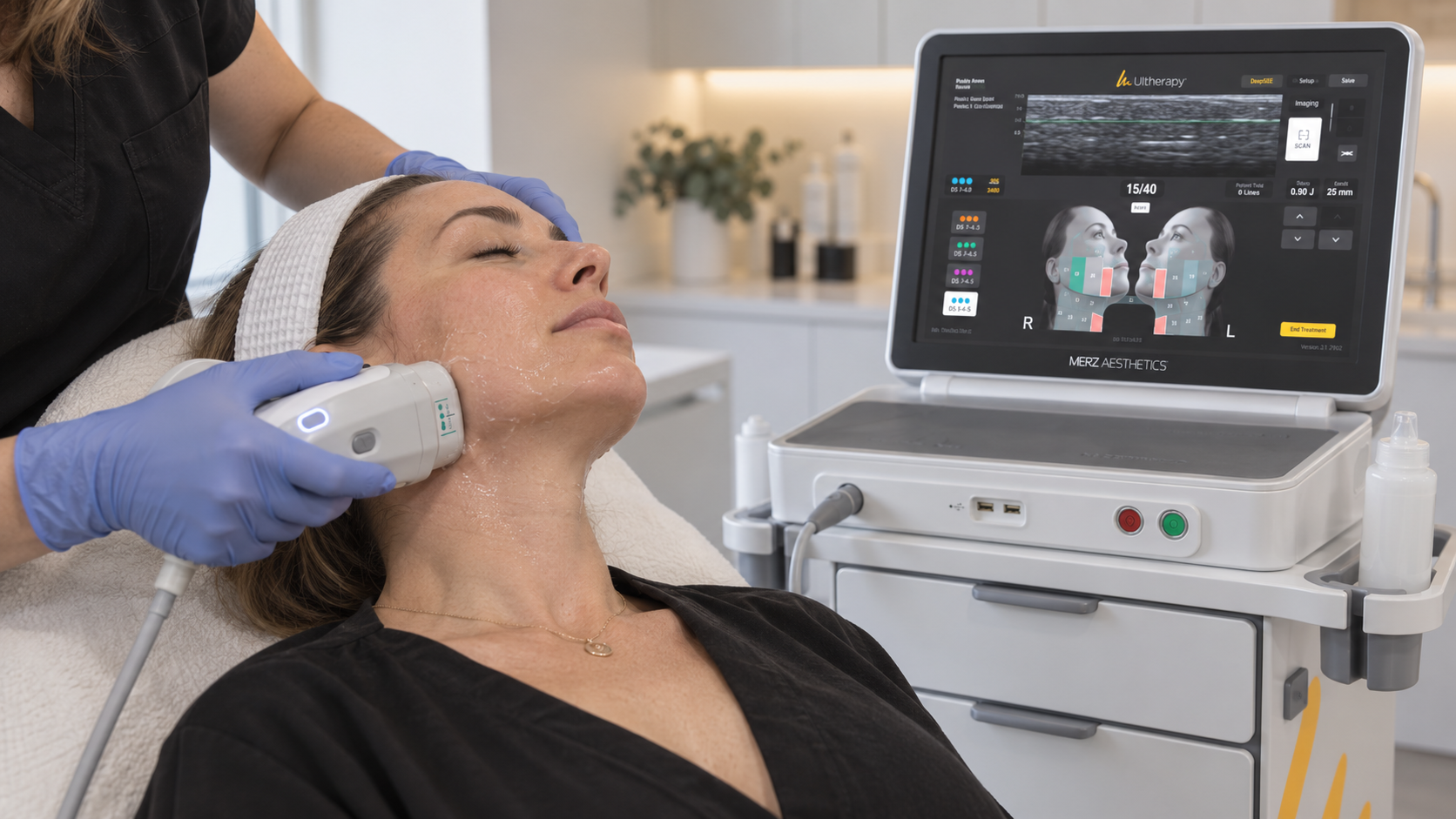
Ultherapy uses focused ultrasound to heat tissue deep under the skin and trigger new collagen, which gradually lifts and tightens the brow, jawline and neck. No surgery, no incisions, no real downtime. Results build over two to six months instead of showing up the next morning.
Most people researching Ultherapy in London, Ontario want one question answered before anything else: does it actually do something? Short version, yes, for the right candidate, and within limits worth understanding before you book.
Demand for lifting is climbing. The American Society of Plastic Surgeons reported that in 2025, forehead and brow lifts rose 29 percent, neck lifts rose 21 percent and facelifts rose 13 percent. Plenty of people want that kind of change without an operation. That gap is where ultrasound lifting sits.
Ultherapy is a non-invasive skin lifting treatment built on microfocused ultrasound with visualization, usually shortened to MFU-V. A handpiece sends ultrasound energy through the skin surface and focuses it at set depths underneath, creating tiny thermal coagulation points. Those points reach roughly 60°C to 70°C. Collagen begins to denature at about 57°C to 58°C, so that heat is doing real structural work.
Energy goes to three depths: 1.5 mm into the superficial dermis, 3.0 mm into the deep dermis, and 4.5 mm into the fibromuscular layer known as the SMAS. That deepest layer is the same one a surgeon tightens during a facelift. Skipping the surface is the point. The epidermis and papillary dermis are left intact, which is why there is no wound to heal afterward.
The visualization part separates this device from most energy treatments. The handpiece doubles as an ultrasound imaging probe, so the provider can see the tissue layers on screen before delivering anything. Merz Aesthetics Canada describes Ultherapy as the only treatment cleared by Health Canada for lifting skin on the neck, under the chin and on the brow, and for smoothing lines on the décolleté, with real-time visualization.
Healing does the rest. Biopsy work tracked in a 2026 CosmoDerma review found fibroblasts moving into the treated tissue around day 14, with new type I collagen and fresh elastin deposited by day 90.
This is the most-searched question about the treatment, and the honest answer comes with conditions.
Yes, ultrasound at these depths measurably remodels collagen and elastin. That is documented histology, not marketing copy. Merz reports more than 3 million Ultherapy treatments performed worldwide and over 120 scientific publications supporting the technology.
But the lift is modest. Cleveland Clinic describes ultrasound skin tightening as suited to mild to moderate laxity in the face and neck, with most people seeing the full effect three to six months after treatment. On RealSelf, Ultherapy holds a 70 percent Worth It rating from 94 recent ratings. That figure is useful precisely because it isn’t 95 percent. A real share of patients felt the result didn’t match what they paid.
Expectation is usually what decides which group someone lands in. A patient hoping for a cleaner jawline and a slightly lifted brow over a few months tends to be happy. A patient expecting jowls to disappear is not.
Cleveland Clinic points to adults aged 30 and older with mild to moderate skin laxity, and notes some younger patients use it preventatively. Merz describes candidates similarly: generally 30-plus, with some degree of laxity, looking for an alternative to a surgical lift.
Skin needs enough underlying structure to respond. Severe sagging, heavy jowls or significantly loose neck skin will not lift meaningfully with ultrasound, and a good consultation says that out loud rather than selling a session anyway.
Cleveland Clinic also lists who should skip it: anyone pregnant or breastfeeding, and anyone with an autoimmune condition such as lupus or rheumatoid arthritis.
At our clinic, a medical provider assesses candidacy before anything gets booked. Ultherapy skin lifting at Infinite Medical Spa covers the brow, jowls, neck, cheeks, chin and décolletage.
Patients feel heat and tingling arriving in waves as energy is delivered. It’s strongest at the deepest 4.5 mm setting and over bony areas like the jaw and brow. Comfortable is not the word for it. Brief is, and most people describe it as tolerable rather than painful.
The ultrasound portion runs 30 to 90 minutes depending on how many areas are treated. The full appointment sits closer to two to three hours once prep and mapping are counted, according to Cleveland Clinic.
There’s no true downtime. Makeup goes on immediately and normal activity resumes the same day. Redness usually fades within an hour. Swelling, tenderness, or small patches of bruising and numbness can hang around longer, occasionally up to a month.
Most patients need one session. Merz states results can last a year or more, with maintenance generally considered every one to two years.
The timeline surprises people more than the treatment does. Very little changes in the first few weeks. Lifting becomes visible around the two to three month mark and keeps improving through six months, which lines up with the day-90 collagen deposition seen on biopsy.
Aging keeps going underneath all of this. Ultherapy slows the visible drift, it does not stop it, and that’s why maintenance exists rather than being an upsell. Some patients pair our approach to Ultherapy with collagen-stimulating injectables like Sculptra and Radiesse, since ultrasound tightens tissue but doesn’t replace lost volume.
One practical note for anyone with a wedding or event in mind. Plan roughly six months ahead, not six weeks.
Both build collagen with heat. They reach different territory.
Ultherapy focuses ultrasound to a fixed depth of up to 4.5 mm without ever breaking the skin, which is what lets it reach the SMAS. RF microneedling drives insulated needles into the dermis and releases radiofrequency energy at the tip. It works shallower, and it treats texture, enlarged pores and acne scarring along the way.
A rough way to sort them. Ultrasound for laxity and lift along the jaw, brow and neck. Radiofrequency microneedling for skin quality and scarring, usually across a series of sessions rather than one.
They aren’t mutually exclusive, and plenty of treatment plans use both. Our guide to non-surgical skin tightening in London, Ontario compares ultrasound, radiofrequency and plasma in more depth.
Cleveland Clinic points to 30 and older as the typical starting range, with mild to moderate laxity being the real criterion rather than a birthday. Some patients in their late twenties use it preventatively. Skin quality matters more than age on paper.
Pricing depends on how many areas are treated in a session, so a single published number would be misleading. Treating the full face and neck costs more than the brow alone. You can book a consultation in London, Ontario for a quote based on the areas you actually want addressed.
Most patients have one. Merz notes that most people see meaningful results after a single session, though some choose a second depending on their starting point and what they want to achieve.
There is no enforced downtime, and normal activity resumes the same day. If you have swelling or tenderness, it’s reasonable to wait a day or two before intense training. Ask your provider about your specific case.
No. Both address the SMAS layer, but a surgeon physically repositions and tightens tissue, while ultrasound stimulates the body to remodel collagen there. The results are smaller and more gradual. For patients with significant sagging, a surgical consult is the more honest recommendation.
This article was medically reviewed by Derek Truong, NP, Medical Director at Infinite Medical Spa. It is intended for general education and is not medical advice. Individual results vary. A consultation with a qualified medical provider is required to determine whether any treatment is appropriate for you.

Derek Truong, NP — Medical Director, Infinite Medical Spa
Derek Truong is a Nurse Practitioner and the Medical Director at Infinite Medical Spa in London, Ontario. He sets our clinical standards and medically reviews our educational content for accuracy and safety. Learn more about our team.
Double Chin Removal in London, Ontario: Is It Fat, Loose Skin or Your Jawline? Medically reviewed by Derek Truong, NP, Medical Director at Infinite Medical

Age Spot Removal in London, Ontario: What Works After Summer Medically reviewed by Derek Truong, NP, Medical Director at Infinite Medical Spa. Age spot removal
Do PDRN Serums Actually Work? A Clinical Review of Topical vs In-Clinic PDRN in London, Ontario Medically reviewed by Derek Truong, NP, Medical Director at
