
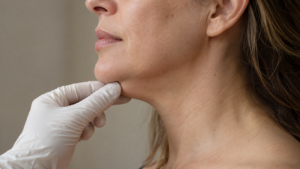
Double Chin Removal in London, Ontario: Fat or Loose Skin?
Double Chin Removal in London, Ontario: Is It Fat, Loose Skin or Your Jawline? Medically reviewed by Derek Truong, NP, Medical Director at Infinite Medical
Medically reviewed by Derek Truong, NP, Medical Director at Infinite Medical Spa.
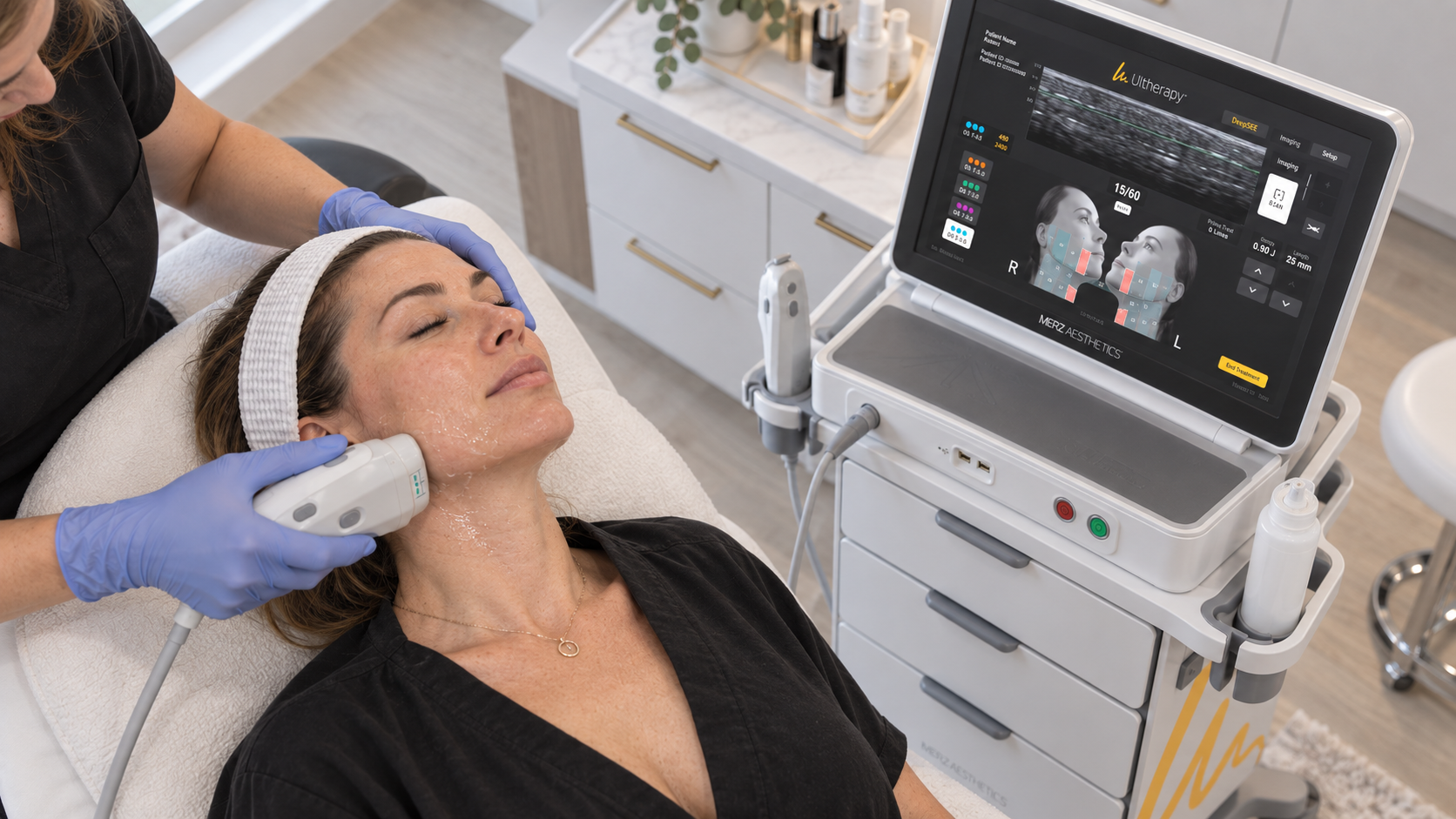
Ultherapy can produce a modest lift along the jawline and under the chin by heating the deep support layer beneath the skin and prompting it to build new collagen. It firms the jaw-to-neck transition. It does not erase established jowls, and no honest consultation will tell you otherwise.
That distinction is the whole reason people search for Ultherapy in London, Ontario and then leave confused. The marketing says lift. The results are real but measured in degrees, not transformations.
Demand for a firmer neck is climbing regardless. The American Society of Plastic Surgeons reported neck lifts up 21 percent in 2025, with facelifts up 13 percent. Surgery is not what most people in their forties want to start with.
Loose skin is the symptom, not the cause. Four things shift at once, and they start well below the surface.
The deep support network gives way first. As the fibromuscular layer and the retaining ligaments that anchor the midface weaken, cheek tissue slides downward and settles along the jawline. Fat compartments move rather than simply vanishing, which is why the midface flattens while the lower face gets heavier. Underneath all of it, the jawbone itself remodels and thins, so the foundation the soft tissue sits on gets smaller. Skin loses collagen and elastin last, and stops springing back.
Here’s why that matters for choosing a treatment. Something that only tightens the surface cannot correct descent that began three layers down. A treatment has to reach the structural layer to move the structure.
Partly. The word to hold onto is lift, not remove.
Ultherapy skin lifting focuses ultrasound to a depth of 4.5 mm, which lands in the fibromuscular layer known as the SMAS. That’s the layer a surgeon repositions during a facelift. Energy creates tiny thermal coagulation points there, reaching roughly 60°C to 70°C. Collagen starts to denature around 57°C to 58°C, so those points sit comfortably above the threshold where tissue contracts and then rebuilds.
The evidence is decent. A 2025 systematic review and meta-analysis in the Aesthetic Surgery Journal pooled 42 studies. For face and neck treatments, investigators recorded improvement in 92 percent of cases, patients reported it in 81 percent, and satisfaction came in at 93 percent.
Look at the gap between 92 and 81. Clinicians see more improvement than patients do. That eleven-point spread is the expectation gap in numerical form, and it’s worth knowing about before you book rather than after.
What a good result actually looks like: a crisper jawline edge, a cleaner transition from jaw to neck, less blur along the lower face. Your jowls do not disappear. They look better supported.
Better than anywhere else, and there’s a regulatory reason for that. Merz Aesthetics Canada describes Ultherapy as the only treatment cleared by Health Canada for lifting skin on the neck, under the chin and on the brow, and for smoothing lines on the décolleté, using real-time visualization. The neck is not an off-label extra here. It is the headline indication.
Visualization earns its keep on the neck more than on the face. Neck skin is thin, and important structures sit close to the surface. Being able to see the tissue layers on screen before delivering energy is a safety feature that matters most exactly where the margin for error is smallest.
The submental area, meaning under the chin, tends to respond well. A 2016 study in the Journal of Clinical and Aesthetic Dermatology treated cheeks, submentum and submandibular regions in 20 patients. At one year, 95 percent were still rated as improved, and 79 percent reported less sagging.
As for what people call turkey neck, it depends entirely on what’s causing it. Laxity responds. A prominent vertical band of neck muscle, or a genuine excess of skin, does not. Those are structural problems that tightening cannot reach.
The sweet spot is roughly late thirties through fifties: early jowling, mild to moderate laxity, skin that still has some recoil left in it. Cleveland Clinic points to adults 30 and older with mild to moderate laxity as the standard candidacy range.
It’s a poor fit when sagging is advanced, when there’s significant excess neck skin, or when the jowl is mostly a volume problem wearing a laxity costume. Cleveland Clinic also lists people who should skip it entirely: anyone pregnant or breastfeeding, and anyone with an autoimmune condition such as lupus or rheumatoid arthritis.
A consultation that tells you a surgical consult would serve you better is doing its job properly. At our clinic that assessment happens with a medical provider before anything is booked.
The ultrasound portion takes 30 to 90 minutes depending on how much ground you’re covering. Budget two to three hours for the full appointment once mapping and prep are counted, according to Cleveland Clinic. Our Ultherapy treatment areas cover the brow, jowls, neck, cheeks, chin and décolletage.
You’ll feel heat and tingling in short waves. It’s sharper along the jaw and under the chin, where there’s less padding between the transducer and bone. The 2025 meta-analysis put average pain for face and neck at 4.62 on a 10-point scale, which matches what most patients describe: uncomfortable in bursts, over quickly.
Aftercare is close to nothing. Makeup goes on the same day and you can go straight back to work.
The same meta-analysis listed the most common side effects as redness, swelling and puffiness, followed by bruising and tenderness, all mild or moderate. Across every study reviewed, none reported acute skin damage or long-term problems such as nerve or muscle dysfunction, scarring, ulceration, or changes in pigment.
Then you wait. Lifting becomes visible around two to three months and keeps developing through six.
Jowls are rarely one problem. Tightening handles descent. It does nothing for the hollow that forms above the jowl when midface volume drops, and a tighter but still-flat midface can read as gaunt rather than lifted.
That’s where structure comes back in. Some patients pair skin tightening with collagen-stimulating injectables like Sculptra and Radiesse to rebuild support in the midface, or use dermal filler along the jawline to sharpen the border the jowl is blurring.
Sequence matters. Tighten first, then reassess volume, because a lift changes how much you actually need. Doing it the other way round means paying to fill a face that was about to change shape.
Our guide to non-surgical skin tightening in London, Ontario compares ultrasound against radiofrequency and plasma if you’re weighing the options.
And when laxity is genuinely advanced, the right answer is a surgical opinion. No amount of ultrasound substitutes for removing skin.
Most patients have one. Merz notes that the majority see meaningful results after a single session, with some choosing a second depending on starting laxity and goals. Maintenance is generally considered every one to two years.
No. A double chin caused by fat under the chin is a volume problem, not a laxity problem, and tightening the skin over it will not reduce it. Ultherapy addresses loose skin in that area, which is a different complaint that often travels alongside it.
They are not competing for the same patient. A neck lift removes and repositions tissue surgically and produces a much larger change. Ultherapy is non-invasive, requires no downtime, and delivers a fraction of that result. For mild to moderate laxity it is a reasonable first step. For advanced sagging it is not a substitute.
Tell your provider exactly what you’ve had and when. Existing filler affects treatment planning and mapping, and the real-time visualization helps the provider work around it. This is a question for your consultation, not the internet.
Six months, not six weeks. Results appear around two to three months and continue improving through six, so an appointment three weeks before a wedding will not show you much on the day. You can book a consultation in London, Ontario to map the timing backward from your date.
This article was medically reviewed by Derek Truong, NP, Medical Director at Infinite Medical Spa. It is intended for general education and is not medical advice. Individual results vary. A consultation with a qualified medical provider is required to determine whether any treatment is appropriate for you.

Derek Truong, NP — Medical Director, Infinite Medical Spa
Derek Truong is a Nurse Practitioner and the Medical Director at Infinite Medical Spa in London, Ontario. He sets our clinical standards and medically reviews our educational content for accuracy and safety. Learn more about our team.
Double Chin Removal in London, Ontario: Is It Fat, Loose Skin or Your Jawline? Medically reviewed by Derek Truong, NP, Medical Director at Infinite Medical

Age Spot Removal in London, Ontario: What Works After Summer Medically reviewed by Derek Truong, NP, Medical Director at Infinite Medical Spa. Age spot removal
Do PDRN Serums Actually Work? A Clinical Review of Topical vs In-Clinic PDRN in London, Ontario Medically reviewed by Derek Truong, NP, Medical Director at
