
Double Chin Removal in London, Ontario: Fat or Loose Skin?
Double Chin Removal in London, Ontario: Is It Fat, Loose Skin or Your Jawline? Medically reviewed by Derek Truong, NP, Medical Director at Infinite Medical
Medically reviewed by Derek Truong, NP, Medical Director at Infinite Medical Spa.
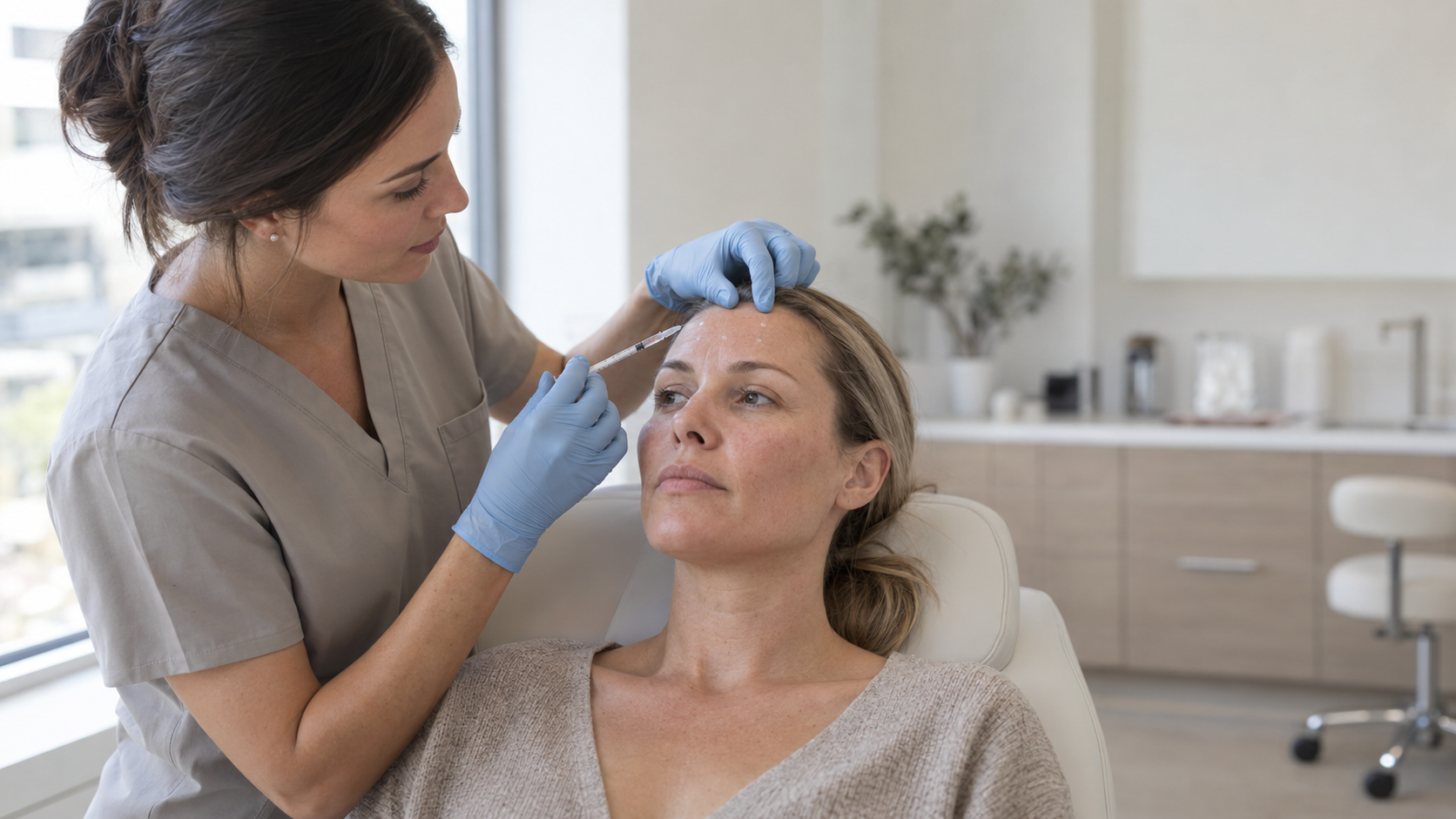
In Ontario, injecting a substance is a controlled act. That one legal fact is the most useful filter you have when you’re deciding where to get Botox, because it means not everyone working in a clinic is allowed to hold the needle. Anyone can call a business a medical spa. The rules about who injects are much narrower than the rules about what you can put on a sign.
Demand keeps climbing. In the United States, the American Society of Plastic Surgeons counted 9,883,711 botulinum toxin procedures in 2024, up 4% from 2023. Canada doesn’t publish a comparable national figure, so treat that as a direction rather than a local number. What it does tell you is that a lot of new clinics have opened to meet that demand, and they are not all the same.
This guide covers who can legally inject in Ontario, how to confirm for yourself that a provider is registered, what a real consultation looks like, and the warning signs worth walking away from. If you’re comparing options for Botox in London, Ontario, start with credentials. Price tells you almost nothing about safety.
Ontario’s Regulated Health Professions Act treats administering a substance by injection as a controlled act. Controlled acts can only be performed by members of a profession authorized to do them, or by someone that authority has been formally delegated to. Botulinum toxin type A is also a prescription drug, and Health Canada’s position is that it should be used only under the supervision of a qualified health care professional.
In practice, cosmetic injections in Ontario are performed by nurse practitioners, physicians, or registered nurses and registered practical nurses working under an order or directive. Nurse practitioners can both prescribe and inject on their own authority. So can physicians.
There’s a wrinkle worth knowing. The College of Physicians and Surgeons of Ontario allows a physician to delegate a controlled act to another individual, and that individual can be unregulated. Delegation is legal and it’s documented. But it also means the title on someone’s name tag doesn’t tell you the whole story, which is why asking who is actually injecting you is a fair question rather than a rude one.
A nurse can. Administering a substance by injection is among the controlled acts authorized to registered nurses and registered practical nurses in Ontario. What a nurse can’t do is independently decide to give you a prescription drug.
The College of Nurses of Ontario is direct about this in its Aesthetic Services practice guideline: when a controlled act or a prescription medication is involved, an authorizing mechanism such as a direct order or directive is required from an authorized provider, for example a nurse practitioner or physician. CNO also sets a bar for what that order has to be. It must be “clear, complete and appropriate,” and appropriateness is judged on an assessment covering your health history, contraindications, physical assessment and the best available evidence. A directive signed off with no real assessment behind it doesn’t meet the standard.
Two more expectations from that guideline are easy to check as a patient. The authorizing provider has to be available for prompt consultation when needed. And the clinic needs the equipment and support staff to manage an adverse outcome, including in an emergency.
So the real question isn’t nurse versus doctor. It’s whether a nurse practitioner or physician is genuinely involved in your care, and whether they’re reachable when something needs attention. At Infinite Medical Spa, injectables are performed by registered nurses and a nurse practitioner, and the clinical team and Medical Director are listed by name and designation so you can look them up.
No. Ontario regulates 27 health professions, each with its own legislation, scope of practice and protected titles. “Medical spa” and “cosmetic injector” are not among them, and no college licenses med spas as businesses.
“Nurse” is a different matter. Only a health professional registered with the College of Nurses of Ontario can be called a nurse.
Premises are worth a separate look. CPSO runs an inspection program for out-of-hospital premises, but it applies to procedures done under general or regional anesthesia or parenteral sedation. Minor cosmetic procedures are not captured by it, and CPSO names botulinum toxin injections specifically in that exclusion. A clinic doing injectables isn’t being inspected the way a surgical suite is. That’s not a reason to avoid injectables. It’s a reason to look closely at the individual clinic, because no inspector is doing that part for you.
You can do this yourself in about two minutes, before you book.
If a clinic’s website won’t give you a full name and designation to search, that’s information you’re entitled to ask for. CNO’s own guidance tells nurses working in aesthetics to include their full name, their professional designation as it appears on the public register, and their role on the care team. A clinic following that guidance makes your homework easy.
CNO published guidance for the public on exactly this. These are the questions it tells patients to ask, and they screen a clinic better than any review page:
The CDC adds two more that take five seconds each. Ask whether the product came from a licensed source. Then ask the provider to draw the product from the labelled vial into the syringe while you watch. Health Canada makes a similar point, telling patients to ask to see the product label and confirm the product has been authorized for sale in Canada.
A clinic that answers all of this without getting defensive is telling you something useful. If you want the background on the treatment itself before the credentials conversation, Botox: The Complete Guide covers how it works and what results look like.
Most of these are visible before you ever sit in the chair.
Every injectable sold in Canada has to be authorized by Health Canada, and authorized products carry an eight-digit Drug Identification Number. The cosmetic botulinum toxin products authorized in Canada include BOTOX Cosmetic (DIN 02243721), Dysport Aesthetic (DIN 02387735), Xeomin Cosmetic (DIN 02383489) and Nuceiva (DIN 02480158). Any of them can be looked up in Health Canada’s Drug Product Database in under a minute.
Health Canada has seized unauthorized and counterfeit injectables from Ontario businesses more than once, including a Hamilton spa in August 2026, a Vaughan spa in September 2022 and a Mississauga spa in October 2021. The warning it repeats across those advisories is blunt: the potential risks of injecting an unauthorized botulinum toxin product “can range from mild local paralysis to death.”
In 2024 the CDC investigated harmful reactions following botulinum toxin injections. As of April 23, 2024, it had reports of 22 people with adverse effects across 11 US jurisdictions. Eleven of them, 55%, were hospitalized, and six received botulism antitoxin. Every one of those people reported receiving injections from unlicensed or untrained individuals, or in non-healthcare settings including homes and spas.
Rushed treatment with no medical history taken is a process problem, and process problems are where complications tend to hide. If nobody asks about your medications, previous treatments or health conditions, that’s the red flag.
Some context, so this doesn’t read as scarier than it is. A 2022 meta-analysis in Aesthetic Surgery Journal pooled 24 studies covering 4,268 cosmetic botulinum toxin sessions in the upper face and found a complication rate of 16%, against 12% for placebo. Headache or migraine accounted for 6.3%, local skin reactions 3.8%. The authors concluded that cosmetic injections in the glabellar and forehead region appear to be safe and that most complications are mild and transient. Side effects happen. Authentic product in trained hands is a different category of risk from the outbreak cases above.
A consultation is an assessment, not a sales appointment. Expect questions about your medical history and medications, a conversation about what you’re actually trying to change, some discussion of which muscles are doing the work in your face, and a plan you’re free to decline.
Skin imaging is a useful addition where a clinic offers it, mostly because it gives you a baseline to compare against months later instead of relying on memory. At Infinite Medical Spa the consultation is free and includes a complimentary VISIA skin analysis, and our approach to cosmetic Botox starts with mapping facial anatomy before anything gets injected.
Pricing should be explained plainly, per unit or per treated area, before you agree to anything. Rates vary quite a bit between clinics in this market. If you want a sense of the range first, what Botox actually costs in London, Ontario breaks it down.
Yes. Administering a substance by injection is within the controlled acts authorized to RPNs as well as RNs. Like RNs, they need an order or directive from an authorized provider such as a nurse practitioner or physician, based on an assessment of you.
You need an assessment. CNO expects the order behind your treatment to rest on your health history, contraindications, a physical assessment and the best available evidence, which is not something anyone can do from a booking form. Many London clinics offer that appointment at no charge, including Infinite Medical Spa.
That depends entirely on who works there and where the product comes from, not on the words on the sign. Since “medical spa” isn’t a regulated title in Ontario, the name tells you nothing. The registration of the person injecting you tells you a lot.
Ask to see the vial and its label, then check the Drug Identification Number against Health Canada’s Drug Product Database. Health Canada specifically advises patients to do this.
Ask about the follow-up policy before you book, not after. CNO expects the authorizing provider to be available for prompt consultation, so a well-run clinic should be able to tell you plainly how it handles a review appointment and who you’d be seeing.
Infinite Medical Spa is at 551 Oxford Street West, Unit 201 in London, Ontario. You can book a consultation or call (519) 709-6494.
This article was medically reviewed by Derek Truong, NP, Medical Director at Infinite Medical Spa. It is general educational information about cosmetic treatment and is not medical advice. Book an assessment with a registered provider to discuss what is appropriate for you.

Derek Truong, NP — Medical Director, Infinite Medical Spa
Derek Truong is a Nurse Practitioner and the Medical Director at Infinite Medical Spa in London, Ontario. He sets our clinical standards and medically reviews our educational content for accuracy and safety. Learn more about our team.
Double Chin Removal in London, Ontario: Is It Fat, Loose Skin or Your Jawline? Medically reviewed by Derek Truong, NP, Medical Director at Infinite Medical

Age Spot Removal in London, Ontario: What Works After Summer Medically reviewed by Derek Truong, NP, Medical Director at Infinite Medical Spa. Age spot removal
Do PDRN Serums Actually Work? A Clinical Review of Topical vs In-Clinic PDRN in London, Ontario Medically reviewed by Derek Truong, NP, Medical Director at
