
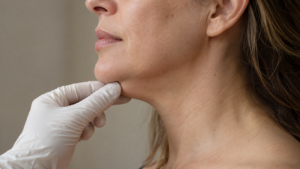
Double Chin Removal in London, Ontario: Fat or Loose Skin?
Double Chin Removal in London, Ontario: Is It Fat, Loose Skin or Your Jawline? Medically reviewed by Derek Truong, NP, Medical Director at Infinite Medical
Medically reviewed by Derek Truong, NP, Medical Director at Infinite Medical Spa.
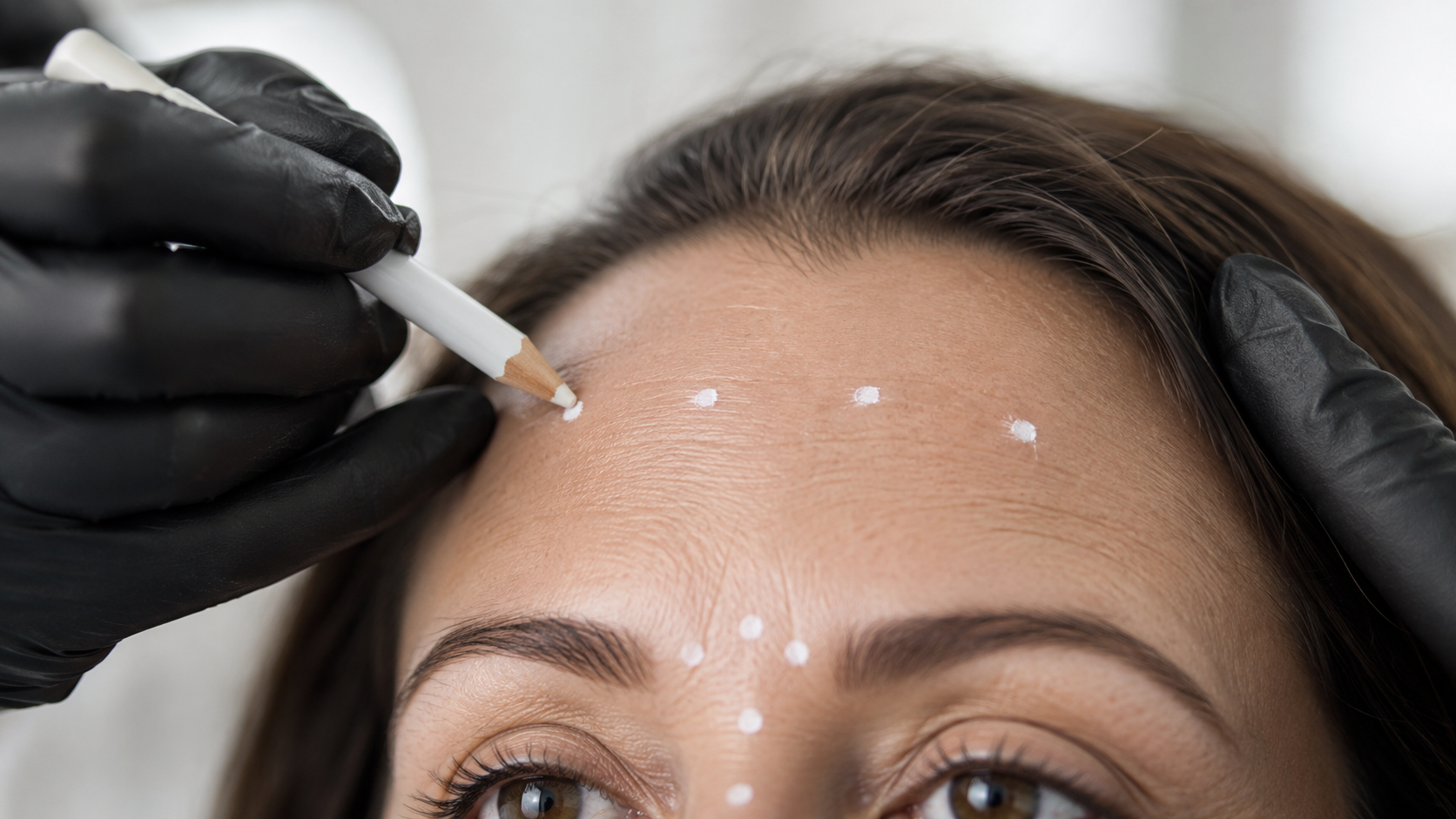
Forehead Botox is a short series of small injections into the frontalis, the muscle that raises your eyebrows. Relax that muscle and the horizontal lines it creases into the skin soften. The effect lasts about four months. Health Canada has approved Botox Cosmetic for upper facial lines, including forehead lines, frown lines and crow’s feet. And demand isn’t slowing: neuromodulator injections made up roughly half of all minimally invasive cosmetic procedures in 2025, according to the American Society of Plastic Surgeons.
This guide explains what forehead Botox in London, Ontario involves: which lines it can soften, how many units are typical, what it costs, when results show, how long they last, and how an experienced injector avoids the heavy brow that comes up in every forum thread. At Infinite Medical Spa, Botox treatments in London, Ontario are performed by nurse injectors with Derek Truong, NP, as Medical Director.
For most adults whose forehead lines appear when they raise their eyebrows, yes. The forehead is one of the three upper-face areas Health Canada has authorized Botox Cosmetic to treat, alongside the frown lines between the brows and crow’s feet.
How well it works depends on the kind of lines you have. Lines that show during muscle movement respond far better than lines that are visible while the face is at rest, according to a 2026 review in American Family Physician. A quick mirror test helps. Raise your eyebrows, then relax them. Lines that appear with the lift and fade when you relax are movement lines, and Botox handles those well. Lines that stay put when your face is still have started to etch into the skin itself. Botox still softens them by stopping the creasing, but it may not erase them, and an injector may suggest pairing it with a skin treatment for the texture that remains.
Botox blocks certain chemical signals from nerves that tell muscles to contract, as Mayo Clinic describes it. A small amount in the frontalis relaxes that muscle for a few months. The skin over it stops being folded dozens of times a day. The horizontal lines soften.
Here is the part that separates a good forehead result from a disappointing one. The frontalis is the only muscle that lifts the eyebrows. A separate group between the brows, the corrugators and the procerus, pulls them down. Fully relax the lifting muscle while leaving the pulling muscles alone, and the brows can settle lower and the eyes can look tired. That is why the frown lines are usually treated at the same visit. A phase 3 study of forehead-line treatment was designed exactly this way, with 20 units in the frontalis and 20 units in the frown-line muscles, for 40 units in total. The Canadian product monograph adds one more safeguard: injections should stay away from the muscle that lifts the upper eyelid, especially in people with large brow-depressor muscles, to reduce the risk of a drooping lid.
The Canadian product monograph for Botox Cosmetic sets out the forehead dose as 2 to 6 units at each of four injection sites in the frontalis, placed every 1 to 2 cm along either side of a deep forehead crease and 2 to 3 cm above the eyebrows, for a total of up to 24 units. The frown lines are dosed separately at 4 units in each of five sites, for 20 units.
Where you land inside that range depends on your muscle. Injectors typically use more units for stronger muscles and taller foreheads, and fewer for a first treatment, then adjust at the two-week check. Someone with a strong lift and a wide forehead may need the full 24 units. Faint early lines? Often far less. For a breakdown by wrinkle severity, read our guide to how many units of Botox the forehead needs.
Most clinics in London price Botox per unit, so the cost is the number of units multiplied by the per-unit rate. A few quote a flat price per area instead. Per-unit pricing in Ontario commonly runs $10 to $15, with some clinics a little lower, as covered in our guide to Botox pricing across Canada.
That makes the math simple. Twenty units on the forehead works out to roughly $200 to $300 before tax. Treating the forehead and the frown lines together at 40 units lands closer to $400 to $600. The final number moves with how many units your injector recommends and the clinic’s per-unit rate. Some clinics also offer Dysport, whose units are measured on a different scale, so compare the price of the full treatment rather than the per-unit rate. One practical tip: ask for the per-unit price and the estimated unit count at your consultation, so you leave with a real quote rather than a range.
A forehead Botox visit starts with an assessment, not a needle. The injector looks at your brow position, checks for asymmetry, watches how your frontalis moves when you raise your eyebrows, and asks what bothers you in the mirror. The injection points are mapped from that, which is why two people with the same complaint can leave with different plans.
Then come the injections, which take minutes. The skin is cleansed, then four or five tiny injections go across the forehead, with five more between the brows if the frown lines are included. There’s no downtime in the usual sense. Most people head back to work right after, with small bumps at the injection sites that usually settle within an hour or so.
Not much, for most people. The product monograph calls for a 30-gauge needle, among the thinnest used in medicine, and each injection takes about a second. Ice or a numbing cream can be used for anyone who is nervous. Bruising is possible at any injection site. Cleveland Clinic recommends avoiding alcohol for 24 hours before treatment and discussing blood-thinning medications and anti-inflammatories with your provider ahead of time, since both make bruising more likely.
Botox usually begins working one to three days after treatment, according to Mayo Clinic, and many people notice the change around day three or four. Full results take longer. Cleveland Clinic puts the complete effect at 10 to 14 days, and the American Family Physician review says clinical effects take about two weeks to fully develop. If you’re taking before-and-after photos, take the “after” at the two-week mark, when the forehead is at its smoothest.
From there, the Canadian product monograph states that the effects last about four months for upper facial lines. Mayo Clinic gives a similar three to four months, and Cleveland Clinic cites three to six months before the muscles regain movement. Mayo Clinic also advises spacing follow-up treatments at least three months apart. For a closer look at what shortens or extends that window, see our article on how long Botox lasts.
Most side effects are mild and short-lived. Mayo Clinic lists pain, swelling or bruising at the injection site and headache or flu-like symptoms. Cleveland Clinic adds redness at the treatment site and temporary drooping eyelids to the list.
Brow heaviness, the complaint that fills forum threads, almost always comes back to placement and dose. Too much product low on the forehead, or a fully relaxed frontalis with untreated frown-line muscles still pulling the brows down, can leave the brows sitting lower than before. The American Family Physician review describes eyebrow droop and eyelid droop as technique-dependent complications whose frequency falls as injector skill rises. When it does happen it is temporary, fading as the product wears off. A careful injector avoids it by treating the frown-line muscles alongside the forehead, keeping the lowest injections well above the brow, and starting conservatively for a first treatment. That is the anatomy-led approach to Botox used at Infinite Medical Spa.
Some people should wait or skip it. Health care providers generally do not recommend Botox during pregnancy or breastfeeding, per Mayo Clinic. The American Family Physician review lists neuromuscular disorders such as myasthenia gravis, an allergy to any ingredient in the product, and keloid scarring as contraindications. An injector will also check whether you already rely on your forehead to hold up heavy upper eyelids, because relaxing it fully in that case can make the eyes feel more tired rather than fresher. And Health Canada has not authorized Botox Cosmetic for anyone under 18.
The “four-hour rule” people search for is about posture. Cleveland Clinic advises staying upright for three to four hours after treatment, so skip the nap and the face-down massage that afternoon. The same guidance says not to rub or put pressure on the treated area for 12 hours and to avoid physical exertion for 24 hours. Normal expressions are fine.
Book a check-in around the two-week mark. That is when the full result is visible, when an injector can see whether one side is working harder than the other, and when a small top-up can even things out.
Good candidates are adults with forehead lines that show on movement, who want a softer forehead that still moves, and who are not pregnant or breastfeeding. Age matters less than the type of line. Botox Cosmetic is authorized for adults, and age on its own doesn’t rule anyone out, so the question “is 40 too late?” gets a direct answer: no. At 40 and beyond, forehead lines are often a mix of movement lines and etched lines, so the plan may pair Botox with a treatment for skin texture. Younger adults with faint early lines sometimes choose lower-dose preventative Botox to keep those lines from setting in.
A consultation is where the plan gets specific. At Infinite Medical Spa, cosmetic Botox in London, Ontario starts with a skin analysis and a mapping of how your forehead, brows and frown lines move together, so the dose fits your anatomy rather than a template. To find out whether your lines are movement lines or etched lines, book a consultation at our clinic at 551 Oxford Street West.
No. Botox Cosmetic is authorized for adults, and it softens movement lines at any age. After 40 the lines are more likely to include some etching at rest, which Botox improves but may not fully erase, so a combined plan is sometimes recommended.
Botox doesn’t build up in the body. Each treatment wears off in about four months, and the muscle moves normally again. Keeping up with treatments simply means the skin spends less time being creased. A frozen look or a dropped brow comes from dose and placement at a given visit, not from the number of years someone has been treated.
At the $10 to $15 per-unit pricing common in Ontario, 20 units works out to roughly $200 to $300 before tax. The exact figure depends on the clinic’s per-unit rate, and the forehead is often treated together with the frown lines, which adds units to the total.
No. The effect is temporary, lasting around three to four months, and the lines return gradually as the muscle regains movement. Lines that only showed on movement tend to return to where they started. Lines that were etched in at rest may gradually soften with consistent treatment, since the skin is no longer being folded as often.
Sometimes, but it isn’t the default. Because the forehead muscle is the only one that lifts the brows, relaxing it on its own can let the brows drop. Many injectors will treat the frown lines at the same time, or use a lower forehead dose, to protect brow position. Your injector will decide based on how your brows sit and how strongly your frown muscles pull.
This article was medically reviewed by Derek Truong, NP, Medical Director at Infinite Medical Spa in London, Ontario. It is for general education and does not replace a consultation. Individual results vary, and a licensed health care provider should assess whether Botox is appropriate for you.

Derek Truong, NP — Medical Director, Infinite Medical Spa
Derek Truong is a Nurse Practitioner and the Medical Director at Infinite Medical Spa in London, Ontario. He sets our clinical standards and medically reviews our educational content for accuracy and safety. Learn more about our team.
Double Chin Removal in London, Ontario: Is It Fat, Loose Skin or Your Jawline? Medically reviewed by Derek Truong, NP, Medical Director at Infinite Medical

Age Spot Removal in London, Ontario: What Works After Summer Medically reviewed by Derek Truong, NP, Medical Director at Infinite Medical Spa. Age spot removal
Do PDRN Serums Actually Work? A Clinical Review of Topical vs In-Clinic PDRN in London, Ontario Medically reviewed by Derek Truong, NP, Medical Director at
