What is PDRN, and is it really salmon DNA?
Yes. PDRN is a purified mixture of DNA fragments extracted from the sperm cells of salmon trout (Oncorhynchus mykiss) or chum salmon (Oncorhynchus keta). The 2017 pharmacology review by Squadrito and colleagues in Frontiers in Pharmacology describes fragments with molecular weights between 50 and 1,500 kilodaltons, most of them in the 80 to 200 kilodalton range, purified at high temperature to a product that is more than 95 percent pure. That heat step inactivates the proteins and peptides that could otherwise trigger an immune response [1].
Two mechanisms are described. PDRN activates the adenosine A2A receptor, which modulates inflammation and angiogenesis and stimulates fibroblast growth, and its breakdown products feed the “salvage pathway” that damaged or hypoxic cells use to rebuild DNA when they cannot synthesize nucleotides from scratch [1]. In the aesthetics literature a related term, polynucleotide (PN), refers to longer DNA chains from the same source. A 2025 review in Pharmaceutics distinguishes them by chain length: PN, with longer fragments, is associated mainly with extracellular matrix remodelling, while PDRN, with shorter fragments, acts through adenosine receptor activation and nucleotide supply [2]. Many clinical papers treat the two as one category, and the systematic reviews cited below include both.
One more fact matters for everything that follows. PDRN is a registered drug: the 2017 review describes it as a proprietary, registered medicine [1], injectable PDRN products are approved prescription drugs in South Korea [2], and randomized studies of its use in wound healing were being published by 2004 [14]. The ingredient is not the controversy. The delivery route is.
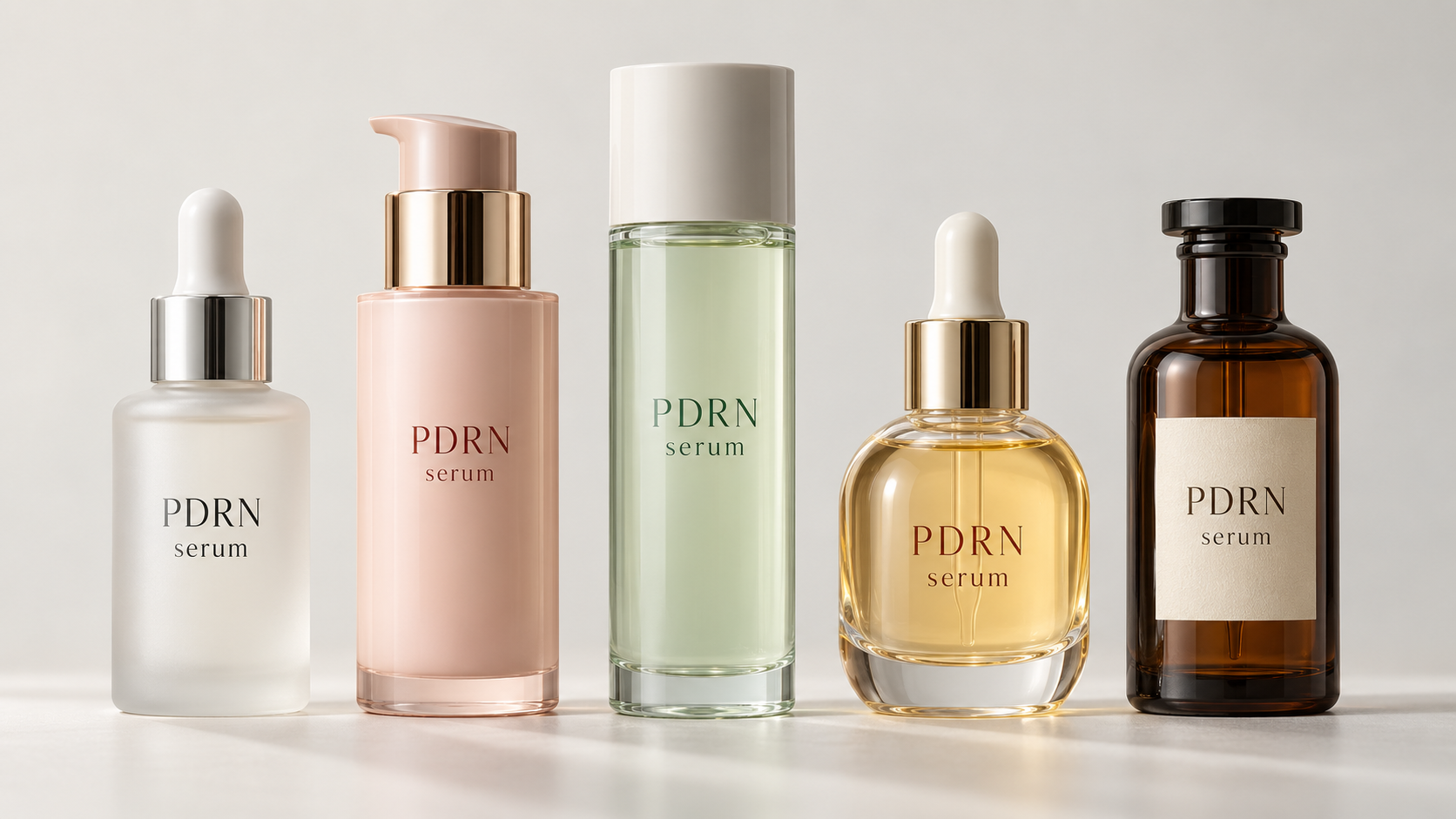
Do PDRN serums work on intact skin?
The barrier problem is a matter of size. In 2000, Bos and Meinardi set out what became known as the 500 Dalton rule in Experimental Dermatology: for a compound to be absorbed through intact human skin, its molecular weight must be under 500 daltons, because larger molecules cannot pass the stratum corneum [4]. PDRN fragments weigh 50,000 to 1,500,000 daltons, which is 100 to 3,000 times that threshold [1, 4]. Passive diffusion from a serum is therefore an unlikely route to the dermal cells PDRN acts on.
That is also the reading of a July 2026 review in Dermatology Times, a trade publication for dermatology clinicians. Its verdict on serums was “honest uncertainty rather than confident dismissal”: the biology is real, the delivery problem is real, and evidence that any specific commercial product has solved delivery well enough to reproduce injectable-scale effects does not yet exist. The review notes that most brands do not disclose the molecular weight of their PDRN, the encapsulation method, or any in vivo data showing dermal delivery, and that visible improvements people report from a serum are plausibly attributable to co-formulated ingredients such as hyaluronic acid, glycerin, niacinamide and peptides [5].
What the newest topical studies add
Two studies published since late 2025 deserve a fair reading, because they are among the first clinical data on topical PDRN applied without a procedure to open the skin.
- A study in the International Journal of Molecular Sciences (published December 2025) tested a low-molecular-weight PDRN extracted from peony (Paeonia lactiflora) rather than salmon. Topical use for two weeks reduced transepidermal water loss in a detergent-damaged skin model (n = 10), and periorbital skin elasticity improved after four weeks of use (n = 10). All six authors were employees of NewLife BST, the company that developed the ingredient [6].
- A study in PLoS One (July 2026) tested a 0.1 percent eye cream built on PDRN-850K, a salmon-derived preparation with an average molecular weight of up to 850 kilodaltons, against 0.1 percent retinol in a randomized, double-blind, split-face design over 28 days in 31 women aged 35 to 55. Confocal Raman spectroscopy showed PDRN-associated signal reaching the viable epidermis over time, which the authors attribute to an endocytosis-sensitive uptake process rather than passive diffusion. The PDRN cream produced approximately twofold greater improvement than retinol in periocular wrinkle, dermal thickness and density measures, with good tolerability. The authors declare no conflicts of interest; the preparation was supplied by its manufacturer [7].
Both are small, both tested a defined preparation made for the study, and neither tested a mass-market serum. The PLoS One result is the more interesting of the two, because its preparation is not a small molecule, and it suggests skin may take up some PDRN by an active mechanism the 500 Dalton rule does not describe. Even there, the delivery evidence reaches the epidermis, not the dermis. These studies show the delivery question is open. They do not show that the serum in a typical shopping cart answers it, and without molecular-weight and penetration data on the label there is no way for a consumer to tell.
What does the evidence show for injected PDRN and polynucleotides?
The clearest proof that PDRN does something when it reaches tissue comes from wound healing, where it is used as a drug. In a randomized, placebo-controlled trial published in the Journal of Clinical Endocrinology and Metabolism in 2014, 216 patients with hard-to-heal diabetic foot ulcers received PDRN by intramuscular and perilesional injection (n = 110) or placebo (n = 106) for eight weeks. Complete wound closure occurred in 37.3 percent of the PDRN group versus 18.9 percent of the placebo group (P = 0.003) [1, 3]. That trial is cited here as evidence of biological activity, not as a treatment offered in an aesthetic clinic.
For skin rejuvenation, the evidence is positive but thinner than social media suggests:
- A randomized, double-blind, split-face trial in the Journal of Dermatological Treatment (27 subjects, three injection sessions two weeks apart) compared an injectable polynucleotide with a non-cross-linked hyaluronic acid filler around the eyes. Patient-rated and global aesthetic improvement scores did not differ significantly between the two sides. Improvement rates for elasticity, hydration, roughness and pore volume were higher on the polynucleotide side, dermal density did not differ, and no serious adverse events were reported [8].
- A 2025 systematic review in the Journal of Cosmetic Dermatology identified nine studies of injected polynucleotides in aesthetic medicine covering 219 patients. It reported promising results for wrinkles, texture and elasticity with mild, transient side effects, graded the studies as low to moderate quality, and called for rigorous trials. Two of its four authors disclose ties to a polynucleotide manufacturer or distributor [9].
- The July 2026 systematic review in Cureus, registered with PROSPERO and restricted to randomized trials, found seven, with 183 participants in total. Its conclusion: benefits were seen across skin rejuvenation, scar prevention and wound healing; the strongest evidence came from wound-healing studies; aesthetic outcomes were “more modest, although consistently favorable”; no serious treatment-related adverse events were reported; and the evidence base remains limited by small samples and the absence of standardized preparations [10].
Regulatory status shapes how this evidence can be used. Injectable PDRN products are approved prescription drugs in South Korea, and polynucleotide injectables are also used in the European Union and several Asia-Pacific countries [2]. None is FDA-approved for cosmetic use in the United States [5]. In Canada, according to Canadian clinic and distributor information, injectable use of PDRN products is not authorized, and PDRN is applied topically after procedures that temporarily open the skin barrier [11]. For a Canadian patient, the practical question is therefore not serum versus injection. It is serum versus in-clinic delivery through microchannels.
What happens when PDRN is applied through microneedling or after a procedure?
Microneedling creates thousands of temporary channels through the stratum corneum. A product applied during and immediately after the pass bypasses the barrier that stops it at the surface, which is why boosters are applied in clinic rather than sent home in a bottle. Two of the seven randomized trials in the 2026 systematic review tested exactly this with PDRN or polynucleotides.
The first, published in Dermatology and Therapy in 2022 and registered as trial TCTR20201105007, enrolled 30 women with Fitzpatrick skin types III to V, 29 of whom completed the protocol. All received three full-face sessions of non-insulated radiofrequency microneedling at two-week intervals, with a topical polynucleotide product applied to one randomly assigned side of the face and saline to the other. On three-dimensional imaging, wrinkle indentation improved earlier on the polynucleotide side, with a significant between-side difference at the two-month follow-up (p = 0.006). Maximum wrinkle depth did not differ between sides at any time point. At six months, 82 percent of subjects rated their improvement at more than 25 percent on both sides, the mean pain score was 2.2 out of 10, and no serious adverse events occurred. The systematic review graded this trial at low risk of bias. The authors concluded that radiofrequency microneedling can serve as a transdermal delivery method and that topical polynucleotides provide additional benefit [10, 12]. The polynucleotide in that trial was a Korean preparation, not VAMP, and the device class is the same category as Potenza RF microneedling in London, Ontario.
The second, published in Aesthetic Medicine in 2025, randomized 24 women aged 30 to 50 with moderate wrinkles and hyperpigmentation to two sessions of microneedling three weeks apart with 3 percent salmon PDRN applied topically immediately afterward (n = 12) or with platelet-rich plasma (n = 12). At six weeks, the mean Lemperle wrinkle score fell from 2.33 to 1.00 in the PDRN group, a 57 percent reduction, versus 2.33 to 1.50 in the PRP group, and the between-group difference favoured PDRN (p = 0.021). Hyperpigmentation scores improved in both groups with no significant difference between them (p = 0.758). Blinding was not reported, and the systematic review rated the trial as having “some concerns” for risk of bias, mainly around reporting [10, 13].
Evidence for topical PDRN on barrier-disrupted skin goes back further. In a 2004 randomized pilot study of 40 patients, topical PDRN applied to skin-graft donor sites produced 98.5 percent re-epithelialization by day 15 versus 53.5 percent with conventional dressing, and complete healing at a mean of 12.5 days versus 24.45 days. The study was unblinded and manufacturer-sponsored, and the review graded it at high risk of bias [10, 14]. A 2026 narrative review in Cureus examined PDRN in recovery after laser resurfacing, chemical peels, microneedling and radiofrequency. It found consistent evidence that PDRN speeds re-epithelialization and reduces post-procedure redness, but most of that evidence comes from surgical and chronic-wound settings; the authors found no randomized trials in human aesthetic cohorts, and noted small samples and variable formulations [15].
This is the context for VAMP. VAMP Advanced, made by Prollenium in Canada, is described by the manufacturer as a topical sterile bio-revitalizing solution of medical-grade PDRN from wild salmon, purified to more than 95 percent, with vitamins, amino acids, minerals and hyaluronic acid, containing five times the PDRN of the original formula [16]. At Infinite Medical Spa it is not injected. It is applied through microneedling channels, the same delivery route the two trials above used, and the full protocol is described in the clinic’s guide to VAMP microneedling in London, Ontario. No published trial has tested VAMP itself. Its evidence is the evidence for the ingredient and the delivery route, not for the brand.
Evidence at a glance
| Study | Design and sample | Delivery route | Comparator | Key finding | Limitations |
|---|
| Squadrito et al., 2014 (JCEM) [3] | RCT, 216 patients with diabetic foot ulcers, 8 weeks | Injection (intramuscular + perilesional) | Placebo | Complete closure 37.3% vs 18.9% (P = 0.003) | Therapeutic wound population, not aesthetic |
| Lee et al., 2022 (J Dermatolog Treat) [8] | Randomized, double-blind, split-face, 27 subjects, 3 sessions | Injection | Non-cross-linked HA filler | Higher improvement rates in elasticity, hydration, roughness, pores; GAIS not different | Small; active comparator only |
| Yogya et al., 2022 (Dermatol Ther) [12] | Randomized split-face, 29 women completed, 6-month follow-up | Topical PN after RF microneedling | Saline after RF microneedling | Earlier wrinkle-indentation improvement (p = 0.006 at 2 months); no difference in maximum depth | Small; low risk of bias |
| Vera et al., 2025 (Aesthet Med) [13] | RCT, 24 women, 2 sessions, 6 weeks | Topical 3% PDRN after microneedling | PRP after microneedling | Lemperle score 2.33 to 1.00 vs 2.33 to 1.50 (p = 0.021); no significant difference in pigmentation | Small; blinding not reported; some reporting concerns |
| Valdatta et al., 2004 (Curr Med Res Opin) [14] | Randomized pilot, 40 patients | Topical PDRN on open donor sites | Conventional dressing | Complete healing 12.5 vs 24.45 days | Unblinded; manufacturer-sponsored; high risk of bias |
| Bak et al., 2026 (Int J Mol Sci) [6] | Topical use; n = 10 detergent-damaged barrier model; n = 10 periorbital elasticity at 4 weeks | Topical low-MW plant PDRN | Baseline | Reduced water loss; improved periorbital elasticity | Very small; manufacturer-employed authors; not salmon PDRN |
| Ye et al., 2026 (PLoS One) [7] | Randomized, double-blind, split-face, 31 women, 28 days | Topical 0.1% PDRN-850K eye cream (average MW up to 850 kDa) | 0.1% retinol | About twofold greater improvement in periocular wrinkle, dermal thickness and density measures | Research preparation; 28-day follow-up; delivery shown to epidermis, not dermis |
| Alhussain et al., 2026 (Cureus) [10] | Systematic review of 7 RCTs, 183 participants | Mixed | Mixed | Benefits across rejuvenation, scars and wounds; strongest evidence in healing tissue; no serious adverse events | Small trials; heterogeneous products |
Is PDRN safe?
The safety record is one of the stronger parts of the PDRN literature. Animal toxicity studies found no organ toxicity with repeated systemic dosing, tolerability in the eight-week diabetic foot ulcer trial was described as excellent, and a five-year post-marketing surveillance programme covering more than 300,000 dispensed prescriptions confirmed the safety profile of the registered drug [1]. Across the seven randomized trials in the 2026 systematic review, no serious treatment-related adverse event was reported, and in the four aesthetic trials local reactions were mild and transient [10].
Three cautions remain. PDRN is salmon-derived, so Infinite Medical Spa asks patients to disclose any fish or seafood allergy at consultation, even though the manufacturing process inactivates the proteins that would ordinarily drive an allergic response [1]. When PDRN is delivered with microneedling, the clinic’s standard microneedling screening applies, including recent isotretinoin use, active infection or breakouts in the treatment area, a history of cold sores, and pregnancy. And the long-term aesthetic data are still limited, so results should be described as progressive and modest rather than transformative [10].
A note on the sources themselves. The authors of the 2017 pharmacology review later disclosed research support from Mastelli, a PDRN manufacturer, and a patent interest in PDRN [19]. The 2025 polynucleotide review has industry-linked authors [9], and the peony study was conducted by the ingredient’s developer [6]. The 2026 Cureus systematic review and the PLoS One trial declare no conflicts of interest [7, 10]. None of this invalidates the findings, but it is the kind of context a careful reader should have.
What this means if you are considering PDRN in London, Ontario
A PDRN serum is best understood as a barrier-support and hydration product whose PDRN content has no demonstrated path into the dermis unless the manufacturer publishes molecular-weight and penetration data. Its other ingredients may still make skin look better. A clinic treatment that places PDRN through microneedling channels is the delivery route the controlled trials tested, and topical application after a procedure is the route available in Canada.
Expectations should match the evidence. The trials report earlier and greater improvement in wrinkle measures, texture and hydration over a series of sessions, together with better post-procedure recovery, not a single-visit transformation. A three- to four-session course spaced several weeks apart is the clinic’s usual protocol, and the booster is chosen after a VISIA skin analysis at a microneedling consultation at Infinite Medical Spa, where PDRN, NCTF and PRP are each matched to the concern being treated. Anyone weighing the serum against the treatment can book a consultation and have the evidence above walked through for their own skin.
Frequently asked questions
Does PDRN work topically?
On intact skin, standard salmon-derived PDRN has no demonstrated route into the dermis: its molecules are 100 to 3,000 times larger than the usual limit for passive absorption [1, 4]. On skin that has been opened by microneedling, randomized trials show topical PDRN or polynucleotides add measurable benefit [10, 12, 13]. Two small studies from 2025 and 2026 suggest specific preparations may be taken up by the epidermis, but those are not the products on most shelves, and neither showed delivery into the dermis [6, 7].
Do dermatologists recommend PDRN?
The published clinician-facing commentary separates the two uses. A 2026 review in Dermatology Times, a trade publication for dermatology clinicians, describes the injectable evidence as genuine science and treats serums with “honest uncertainty” because delivery is unproven and formulations are undisclosed [5]. Systematic reviewers consistently call for larger trials before PDRN is positioned as a standard rejuvenation treatment [9, 10].
Is PDRN skincare worth it?
That depends on what is being paid for. If the goal is hydration and barrier support, a PDRN serum may deliver that through its other ingredients. If the goal is the collagen and texture changes shown in trials, the evidence points to in-clinic delivery, and a serum should not be expected to substitute for it [5].
How long does it take for PDRN to show results?
In the two microneedling trials, the PDRN or polynucleotide arm separated from its comparator at two months in the split-face trial and at six weeks in the parallel-group trial, and improvement continued through six months of follow-up in the former [12, 13]. Collagen-related change follows the slower microneedling timeline, which is why both trials used a series of sessions rather than one.
Is PDRN the same as the “vampire facial”?
No. The vampire facial uses platelet-rich plasma drawn from the patient’s own blood, while PDRN is a manufactured, salmon-derived DNA product. One randomized trial compared the two after microneedling and found greater wrinkle reduction with PDRN at six weeks and no significant difference in pigmentation [13]. The clinic’s comparison of PRP versus PDRN boosters covers how each is chosen.
Is VAMP injected?
No. VAMP Advanced is described by its manufacturer as a topical sterile solution for aesthetic providers [16]. In Canada, PDRN products are applied topically after procedures such as microneedling, RF microneedling or laser, since injectable use is not authorized [11].
Sources
- Squadrito F, Bitto A, Irrera N, et al. Pharmacological Activity and Clinical Use of PDRN. Front Pharmacol. 2017;8:224.
- Kim ST. Comparison of Polynucleotide and Polydeoxyribonucleotide in Dermatology: Molecular Mechanisms and Clinical Perspectives. Pharmaceutics. 2025;17(8):1024.
- Squadrito F, Bitto A, Altavilla D, et al. The effect of PDRN, an adenosine receptor A2A agonist, on the healing of chronic diabetic foot ulcers: results of a clinical trial. J Clin Endocrinol Metab. 2014;99(5):E746-E753. PMID 24483158.
- Bos JD, Meinardi MM. The 500 Dalton rule for the skin penetration of chemical compounds and drugs. Exp Dermatol. 2000;9(3):165-169.
- Bosslett M. Social Media Mythbusters: PDRN Serums. Dermatology Times. July 11, 2026.
- Bak SU, Jung MS, Kim DJ, Jin HU, Lee SY, An CE. Anti-Aging Efficacy of Low-Molecular-Weight Polydeoxyribonucleotide Derived from Paeonia lactiflora. Int J Mol Sci. 2026;27(1):220. Published December 24, 2025.
- Ye R, Wang Q, Du L, Li L, Hu F. Topical medium-length PDRN enhances dermal extracellular matrix repair in photodamaged skin via PI3K-Akt/TGF-β-regulated pathways. PLoS One. 2026;21(7):e0350905.
- Lee YJ, Kim HT, Lee YJ, et al. Comparison of the effects of polynucleotide and hyaluronic acid fillers on periocular rejuvenation: a randomized, double-blind, split-face trial. J Dermatolog Treat. 2022;33(1):254-260.
- Lampridou S, Bassett S, Cavallini M, Christopoulos G. The Effectiveness of Polynucleotides in Esthetic Medicine: A Systematic Review. J Cosmet Dermatol. 2025;24(2):e16721.
- Alhussain AM, Albusayys STM, Alfhadi MA, et al. Polynucleotides and Polydeoxyribonucleotides for Skin Rejuvenation, Postoperative Scar Prevention, and Wound Healing: A Systematic Review of Randomized Clinical Trials. Cureus. 2026;18(7):e112403. PROSPERO CRD420261418096.
- Dermapure. Rejuran: A PDRN Salmon DNA Facial. Canadian clinic network’s statement on the regulatory status of injectable PDRN in Canada. Updated September 28, 2026.
- Yogya Y, Wanitphakdeedecha R, Wongdama S, Nanchaipruek Y, Yan C, Rakchart S. Efficacy and Safety of Using Noninsulated Microneedle Radiofrequency Alone versus in Combination with Polynucleotides for Treatment of Periorbital Wrinkles. Dermatol Ther (Heidelb). 2022;12(5):1133-1145. Trial registration TCTR20201105007.
- Vera V, Praharsini IG, Darwinata AE, Wahyuni N, Wahyuniari IA, Ernawati DK. Comparison of microneedling and polydeoxyribonucleotide salmon 3% versus microneedling and platelet rich plasma in treating wrinkles and facial hyperpigmentation. Aesthet Med. 2025;11(2):16753.
- Valdatta L, Thione A, Mortarino C, Buoro M, Tuinder S. Evaluation of the efficacy of polydeoxyribonucleotides in the healing process of autologous skin graft donor sites: a pilot study. Curr Med Res Opin. 2004;20(3):403-408.
- Flores Rodríguez JC, Toledo Avelar LE, Yi K, Merino Arellano R, Porras Zamora BM, Valdovinos Martínez L. Polydeoxyribonucleotide (PDRN) in Post-procedure Recovery in Aesthetic Medicine: A Narrative Review. Cureus. 2026;18(5):e108886.
- Eferighe J. Prollenium Launches VAMP Advanced, a Patent-Pending PDRN Solution. MedEsthetics. March 16, 2026.
- Google Trends. Search interest for “pdrn” in Canada, past 12 months. Retrieved October 2, 2026.
- CosmeticsDesign USA. Spate identifies top two products currently leading US facial serum growth. August 20, 2025.
- Squadrito F, Bitto A, Irrera N, et al. Corrigendum: Pharmacological Activity and Clinical Use of PDRN. Front Pharmacol. 2022;13:1073510.
This article was medically reviewed by Derek Truong, NP, Medical Director at Infinite Medical Spa. It is for general education only and is not a substitute for a personal consultation. Individual results vary.