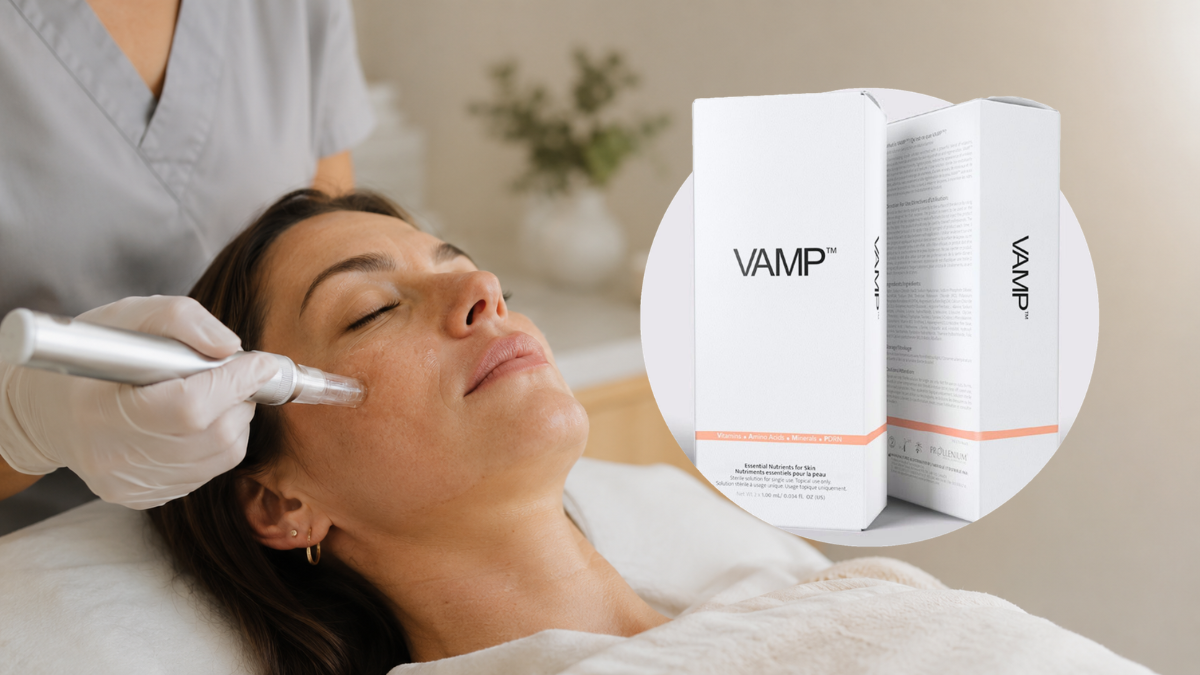
What is VAMP microneedling?
VAMP is made by Prollenium, an aesthetics company based in Richmond Hill, Ontario. The original formula launched in February 2025 as a sterile bio-revitalizing solution combining PDRN with vitamins, amino acids and minerals. A second version, VAMP Advanced, followed in March 2026.
The Advanced formula is the one most Canadian clinics now stock. It contains 0.5% medical-grade PDRN from wild salmon, purified to more than 95%, along with 11 vitamins, 23 amino acids, 6 minerals and low molecular weight hyaluronic acid that has not been cross-linked. That is five times the PDRN of the original formula. Prollenium manufactures it in a GMP-certified North American facility.
VAMP on its own is just a serum. Microneedling is the delivery method. Pairing them is the treatment.
What is PDRN, and is it really salmon DNA?
Yes, and the internet nickname is accurate. PDRN is a mixture of short DNA fragments, roughly 50 to 2,000 base pairs long, extracted from the sperm of salmon trout or chum salmon and then purified to strip out proteins and other cell material. Salmon is used because the DNA is structurally close to human DNA and straightforward to source at scale.
Two mechanisms show up repeatedly in the literature. The first is activation of the adenosine A2A receptor, which raises intracellular cAMP and, through protein kinase A, influences fibroblast and endothelial cell activity along with VEGF production. The second is the salvage pathway, where the DNA fragments supply nucleotides that cells can reuse for repair instead of building them from scratch.
Fibroblasts are the cells that make collagen. That is the connection people care about.
Why does VAMP get applied with microneedling?
Intact skin is a barrier, and it is a good one. Large molecules applied to the surface mostly stay on the surface. Microneedling changes the math. Cleveland Clinic describes the process as small needles removing the very superficial layer of the skin and stimulating new collagen to form, and those needle passes leave temporary channels behind.
Serum applied during and immediately after the pass reaches further into the skin than the same serum ever would from a bottle at home. Those channels close within hours, so timing matters. That is the logic behind microneedling with a booster, and the reason boosters are offered as in-clinic add-ons rather than take-home products.
If you are weighing options locally, our page on microneedling in London, Ontario has more detail on how treatments are planned.
What does the research on PDRN actually show?
Here is where honesty matters more than enthusiasm.
A 2021 review in Pharmaceuticals by Squadrito and colleagues covers the preclinical picture. PDRN stimulated fibroblast growth and increased type I and type III collagen in wound models. Acute and chronic toxicity studies in mice and rats found no toxic effects in major organs, and clinical tolerability has been reported as excellent.
A 2026 narrative review in Cureus looked specifically at PDRN in post-procedure recovery in aesthetic medicine. Across randomized trials, cohort studies and split-face designs, the author found PDRN shortened re-epithelialization time, reduced how long redness lasted and lowered pigmentation complications after procedures. The adverse event profile was consistently favourable.
The same review is blunt about the gaps. There are not enough randomized controlled trials in human aesthetic cohorts, sample sizes are small, formulations vary between products, and long-term follow-up data barely exists. The reasonable read is that PDRN looks promising for skin quality and post-treatment comfort, and that anyone promising specific long-term outcomes is running ahead of the evidence.
How many sessions does it take, and what is recovery like?
Canadian clinics offering VAMP typically recommend a series of three to four sessions spaced a few weeks apart, with some clients reporting improved hydration and radiance after a single treatment. Protocols vary by provider and by skin.
Microneedling itself has a well-documented timeline. Cleveland Clinic recommends treatments three to eight weeks apart, with best results developing over three to six months and maintenance roughly once a year. Expect mild pinpoint bleeding during and right after the pass. Redness and swelling can last up to five days, though skin is usually only mildly red for about 24 hours.
Adding VAMP does not meaningfully extend downtime. Mild redness, sensitivity or a warm feeling for 24 to 48 hours is the common report. Our guide on what to do after microneedling covers the aftercare that matters most, and sun protection is the part people skip.
VAMP, PRP or NCTF: how the boosters compare
Three boosters come up most often at consultations, and they are not interchangeable.
VAMP
A manufactured sterile serum. Nothing is drawn from you, there is no processing time during the appointment, and the composition is identical every session.
PRP
Platelet-rich plasma uses your own blood. A vial is drawn and spun in a centrifuge to concentrate platelets and growth factors, which are then applied through the microneedling channels. It appeals to people who want an autologous option, and it adds a blood draw to the visit.
NCTF 135 HA
A medical-grade complex with more than 55 active ingredients, including hyaluronic acid, vitamins, amino acids, minerals and antioxidants. Our post on the NCTF 135 HA booster goes deeper on how it is used and what aftercare looks like.
Which one suits you depends on your skin goals, your budget, whether a blood draw is a dealbreaker and what your provider finds on assessment. None of the three is the right answer for every face.
Who is a good candidate for VAMP microneedling?
VAMP microneedling is generally used for dull or dehydrated skin, fine lines, uneven skin tone, enlarged pores and texture concerns. It is also used to support comfort and recovery after other in-clinic procedures.
A few things need to come up at consultation. Cleveland Clinic advises stopping isotretinoin at least six months before microneedling. A history of cold sores may call for prophylaxis. Active skin infection, breakouts in the treatment area and pregnancy all need a provider’s assessment first. Mention any fish or seafood allergy as well, since PDRN is salmon derived, even though the material is highly purified.
Curious how the treatment itself works before booking? Start with our explainer on what microneedling does, then look at our microneedling and booster options to see how VAMP fits into a plan.
Frequently asked questions
Is VAMP injected?
No. VAMP is a topical solution. It is applied to the skin surface and delivered through the channels created by microneedling, dermal rolling or a post-laser pass.
Does VAMP microneedling hurt?
The sensation comes from the microneedling, not the serum. Topical numbing is applied beforehand, and most people describe the pass as pressure with occasional prickling. Some clients report a warm or tingling feeling as the serum goes on.
How soon will I see a difference?
Hydration and surface smoothness are often the first things people notice, within days. Collagen-related changes are slower. Cleveland Clinic notes that microneedling results develop over three to six months, and individual outcomes vary.
How is VAMP different from injected salmon DNA treatments?
Injected polynucleotide products are placed into the skin with a needle or cannula by a qualified provider. VAMP is not injected. It is a topical serum, which means the depth it reaches depends on the microneedling settings used during the treatment.
Can VAMP be used after a laser treatment?
The manufacturer lists post-laser application as one of its intended uses. Whether it suits your skin after a specific laser depends on the device, the depth of treatment and your provider’s judgment.
Sources
- Prollenium Unveils VAMP, The Next Generation of PDRN Skin Boosters (February 2025)
- Prollenium Launches VAMP Advanced, a Patent-Pending PDRN Solution, MedEsthetics (March 2026)
- Squadrito F, et al. Polydeoxyribonucleotide: A Promising Biological Platform to Accelerate Impaired Skin Wound Healing. Pharmaceuticals. 2021;14(11):1103
- Valdovinos Martínez L. Polydeoxyribonucleotide (PDRN) in Post-procedure Recovery in Aesthetic Medicine: A Narrative Review. Cureus. 2026;18(5)
- Cleveland Clinic. Microneedling
- ISAPS Global Survey 2024
This article was medically reviewed by Derek Truong, NP, Medical Director at Infinite Medical Spa. It is general education, not medical advice. Individual results vary, and suitability for any treatment is determined at consultation.