
Double Chin Removal in London, Ontario: Fat or Loose Skin?
Double Chin Removal in London, Ontario: Is It Fat, Loose Skin or Your Jawline? Medically reviewed by Derek Truong, NP, Medical Director at Infinite Medical
Medically reviewed by Derek Truong, NP, Medical Director at Infinite Medical Spa.
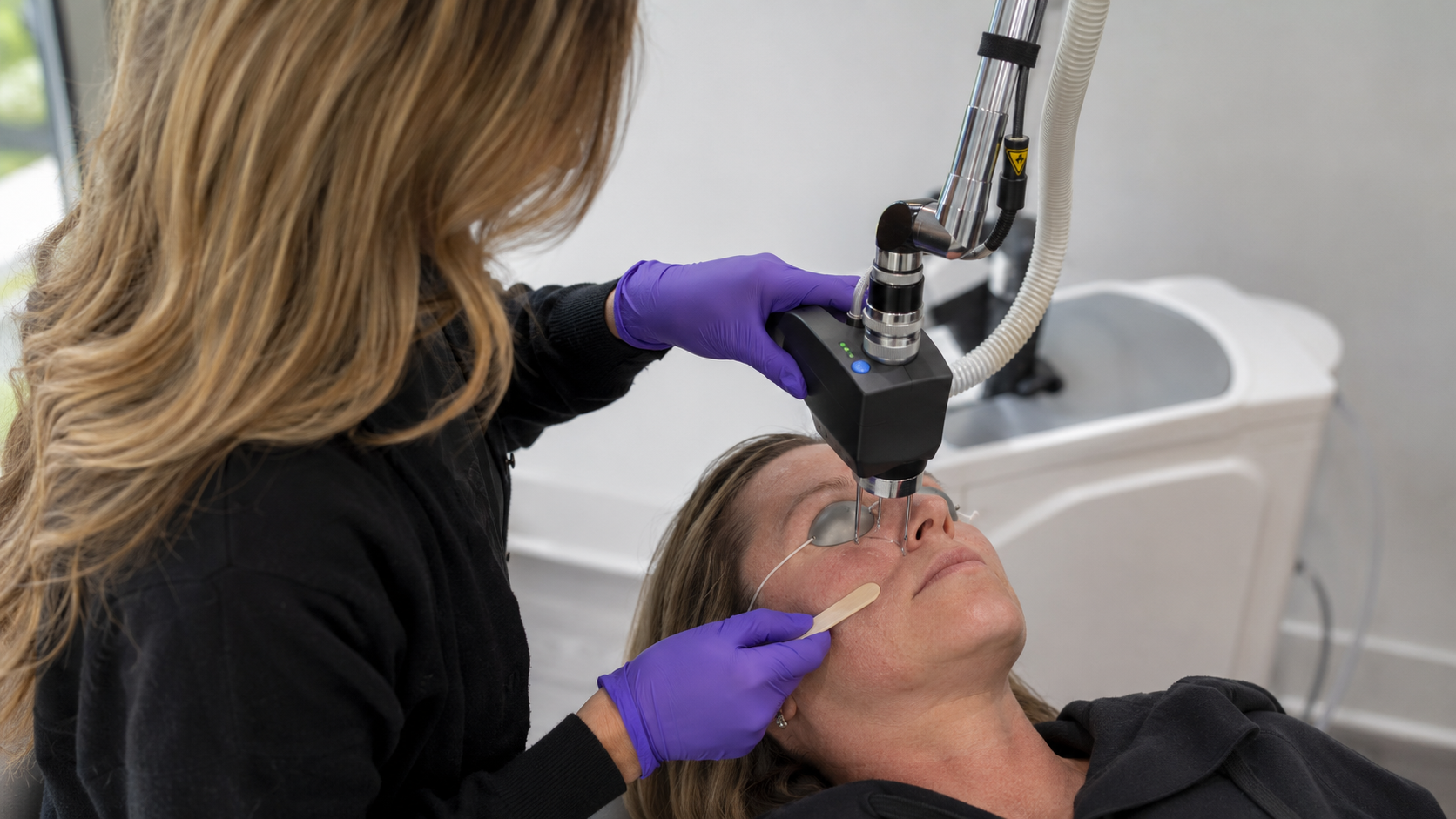
If you have been comparing CoolPeel vs CO2 laser resurfacing, here is the short answer: they are the same laser. CoolPeel is a CO2 laser treatment, run by the same device at a shallower depth with a much shorter pulse. One is not the gentle alternative to the other. They are two settings on one machine, and the right setting depends on how deep your concern goes and how many days you can take off.
The category keeps growing. The American Society of Plastic Surgeons counted more than 3.7 million skin resurfacing procedures in 2024, up 6 percent on the year before. This guide covers what changes between the two depths, what recovery looks like, and how to tell which one fits. It reflects how CO2 laser resurfacing in London, Ontario is planned at Infinite Medical Spa, where both depths run on one DEKA platform under the oversight of Derek Truong, NP, the clinic’s on-site Medical Director.
Yes. CoolPeel is a treatment mode on a fractional CO2 laser, not a separate technology. Same 10,600 nanometre peak wavelength a CO2 laser emits, preferentially absorbed by water inside skin cells, heating it fast enough that the targeted tissue vaporizes.
The confusion makes sense, because CoolPeel is a brand name rather than a category. It refers to a specific short-pulse setting on the DEKA SmartXide platform, sold as its own treatment. So anyone asking whether to book CoolPeel or a CO2 laser is really asking which depth to book.
It is. That surprises people, because CoolPeel gets marketed next to gentler non-ablative treatments, but it still removes tissue. Ablative means the laser vaporizes the outer layer rather than heating it from underneath.
What changes is how much comes off. The manufacturer’s white paper on the SmartXide platform describes CoolPeel’s High Pulse mode working at a controlled penetration depth of 20 to 70 microns. A fraction of a millimetre. Traditional CO2 settings reach considerably deeper into the dermis, which is where etched lines and pitted scars actually sit.
Depth, and how long each pulse lasts. Pulse duration is one of the factors behind the recovery gap, and it has been studied directly.
A 1996 study in Lasers in Surgery and Medicine by Ross and colleagues tested CO2 laser pulses from 0.25 to 10 milliseconds on a porcine skin model and reported that pulses longer than 1 millisecond were associated with higher ablation thresholds and localized increased thermal damage. The same authors noted that irradiance, meaning the intensity of the beam, was the stronger predictor of the result. In plain terms, a slower pulse tends to leave more heat behind in the surrounding tissue.
That leftover heat is not wasted. In traditional CO2 resurfacing it contracts existing collagen and drives a remodelling process that can continue for months. It is also the main reason recovery takes longer. CoolPeel trades much of that for a faster return to normal life. Both depths run on the same DEKA CO2 platform, so the choice gets made at your appointment.
Worth setting expectations here, because a published figure and an individual recovery are not always the same thing. The manufacturer’s white paper reports 0 to 2 days of social downtime.
At Infinite Medical Spa the planned figure is 2 to 4 days of social downtime for CoolPeel, 7 to 10 days for traditional CO2. Schedule around those. Expect redness like a strong wind burn, then fine sandpapery flaking as the surface sheds.
Traditional CO2 asks for more. StatPearls puts re-epithelialization, the point where new skin has covered the area, at about 6 to 7 days. Cleveland Clinic reports that redness at treated sites generally fades in 2 to 3 months, though for some people it takes six months or longer. Daily SPF 30 or higher is non-negotiable through all of it, whichever depth you pick.
CoolPeel is built as a series. At Infinite Medical Spa that usually means 2 to 4 sessions spaced 4 to 6 weeks apart, so results stack over a few months. The manufacturer’s white paper followed 12 participants averaging 45 years old, skin types I to III, through 3 to 4 sessions and reported improvement in pore size, texture and fine lines. Small study, worth reading as one. But the structure matches how the treatment gets used in practice.
Traditional CO2 works the other way round. Usually 1 to 3 sessions, and one deeper treatment is often enough on its own, which is what Mayo Clinic notes about fully ablative resurfacing. A common plan is one deeper session, then lighter CoolPeel visits later to hold it.
Match the depth to the concern, then check it against your calendar.
Fine lines, mild rough texture, uneven tone and pores that look larger than they should. It is also the practical pick when you cannot disappear for a week and a half.
Deep wrinkles and etched expression lines, significant acne scarring, accumulated sun damage. If the concern runs deep, a series of light treatments will not substitute for one that reaches far enough.
Skin type matters too. Mayo Clinic notes the risk of hyperpigmentation or hypopigmentation after ablative resurfacing is higher in people with brown or Black skin, and depth is one lever a provider can use alongside settings and pre-treatment preparation. Mayo Clinic also lists cautions against ablative resurfacing for anyone who has taken a strong prescription oral acne medication in the past year, has a history of keloid scarring, is prone to cold sores or has had a recent outbreak, or is pregnant or breastfeeding. A CO2 laser consultation is where that gets assessed, and every first visit at Infinite Medical Spa includes a complimentary VISIA skin analysis that maps wrinkles, pores, texture and UV damage.
CoolPeel gets compared to a lot of things, mostly because they share the same two-to-four-day downtime bracket. They work differently though.
Potenza RF microneedling delivers radiofrequency heat through fine needles without removing the surface at all. It works deeper than a surface resurfacing pass while leaving the surface intact, so it is more often chosen for laxity and crepey texture. CoolPeel resurfaces the actual surface, so it does more for tone and how the skin feels.
An M22 IPL photofacial is not resurfacing at all. It uses broad-spectrum light on sun spots, age spots and redness rather than on surface texture. People weighing CoolPeel against IPL usually want both, so the two are often planned as separate treatments. Medium-depth chemical peels overlap more than expected, since a peel and a light resurfacing session both remove a controlled layer of skin by different means.
Depends on what you want to change. For surface texture and early lines, a short series is a reasonable way to get resurfacing benefit without booking time off. For deep scarring or etched lines it is the wrong tool, and repeating it can cost more than one deeper treatment while doing less.
The honest failure mode is picking CoolPeel for the downtime instead of the concern, then feeling underwhelmed. That is why depth is decided at the consultation, against what your skin actually needs rather than against the calendar.
Most people describe brief heat and prickling rather than sharp pain, and topical numbing is typically applied beforehand. Being shallower and faster, it is generally the more comfortable of the two.
No. Fraxel is a different manufacturer’s family of fractional devices. The widely used Fraxel Dual is non-ablative at 1550 and 1927 nanometres, though Fraxel re:pair is an ablative CO2 device. Both families are fractional, which is where the mix-up starts.
Typically at different points rather than in one session. A frequent plan is a deeper treatment first, then lighter sessions later for upkeep.
Pigment risk after any ablative laser is higher in deeper skin tones, so this needs an individual assessment rather than a blanket answer. Depth, settings and preparation all get adjusted, and sometimes a different treatment is the better call. The Perfect Derma Peel, one of the chemical peels offered in London, Ontario, is one option that often comes up in that conversation.
Fall through early spring. New skin needs consistent sun protection, easier in this city between October and April, and it leaves room to finish a full series before summer.
This article was medically reviewed by Derek Truong, NP, Medical Director at Infinite Medical Spa. It is for general education only and does not replace a personal consultation. Individual results vary.

Derek Truong, NP — Medical Director, Infinite Medical Spa
Derek Truong is a Nurse Practitioner and the Medical Director at Infinite Medical Spa in London, Ontario. He sets our clinical standards and medically reviews our educational content for accuracy and safety. Learn more about our team.
Double Chin Removal in London, Ontario: Is It Fat, Loose Skin or Your Jawline? Medically reviewed by Derek Truong, NP, Medical Director at Infinite Medical

Age Spot Removal in London, Ontario: What Works After Summer Medically reviewed by Derek Truong, NP, Medical Director at Infinite Medical Spa. Age spot removal
Do PDRN Serums Actually Work? A Clinical Review of Topical vs In-Clinic PDRN in London, Ontario Medically reviewed by Derek Truong, NP, Medical Director at
