
Double Chin Removal in London, Ontario: Fat or Loose Skin?
Double Chin Removal in London, Ontario: Is It Fat, Loose Skin or Your Jawline? Medically reviewed by Derek Truong, NP, Medical Director at Infinite Medical
Medically reviewed by Derek Truong, NP, Medical Director at Infinite Medical Spa.
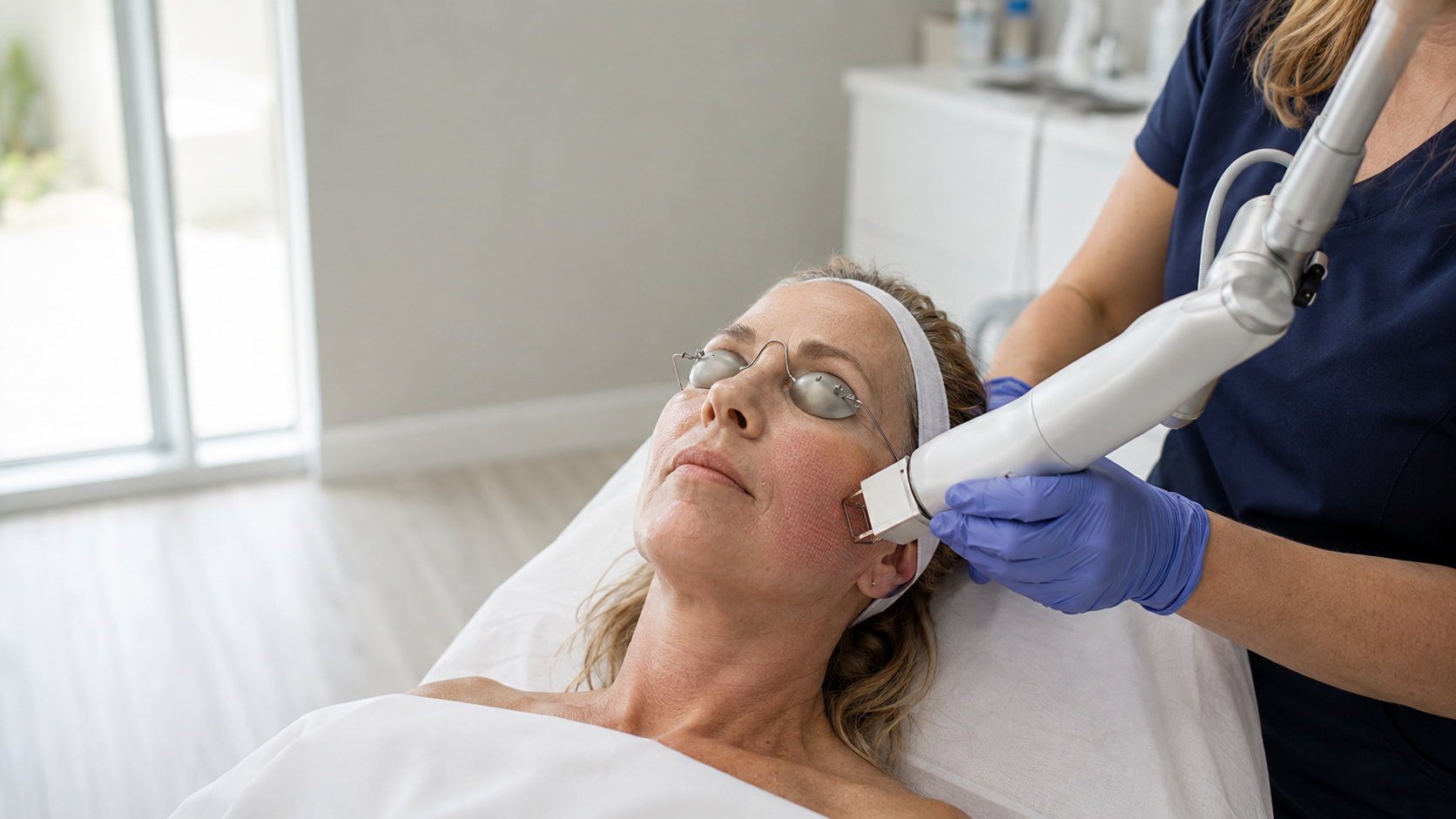
CO2 laser treatment is an ablative skin resurfacing procedure. The laser removes damaged outer layers of skin and heats the tissue underneath, which triggers new collagen and smooths deep wrinkles, acne scars, sun damage and rough texture. Interest is climbing fast. A Google Trends study published in JMIR Medical Informatics found that public search interest in CO2 lasers in Germany rose 354 percent between 2020 and 2025, with searches peaking every January. In the United States, the American Society of Plastic Surgeons counted more than 3.7 million skin resurfacing procedures in 2024. That’s up 6 percent from the year before.
This guide explains how a CO2 laser works, what it treats, what recovery looks like day by day, how long results last and what it costs in Canada. It also reflects how CO2 laser skin resurfacing in London, Ontario is planned at Infinite Medical Spa, where treatments are performed by experienced nurses under the oversight of Derek Truong, NP, the clinic’s on-site Medical Director.
A CO2 laser produces light at a wavelength of 10,600 nanometres, which is absorbed by the water inside skin cells. That water heats instantly when the beam lands, and the damaged surface layer vaporizes. Just below the treated zone, the leftover heat tightens existing collagen fibres and sets off a repair response that keeps building new collagen for months.
Early CO2 lasers treated the whole surface at once. Fractional systems, introduced in 2004, split the beam into many tiny columns and leave the skin between them untouched, so healing is faster and side effects are fewer. Depth is adjustable too. At Infinite Medical Spa, the DEKA CO2 platform runs two ways: a deeper traditional ablative treatment for etched lines and scars, and CoolPeel, a very short-pulse setting that resurfaces with far less residual heat. Both traditional CO2 and CoolPeel treatments are matched to the concern and to the downtime a person can realistically take.
Cleveland Clinic lists acne scars, age spots, uneven pigmentation, sun damage, and fine lines and wrinkles among the concerns laser resurfacing can improve. CO2 is the pick when the goal is a visible change in texture. Rolling and boxcar acne scars. Vertical lines around the mouth. Crepey skin on the neck and chest, and pores that look larger than they should. It’s the deepest option in the clinic’s range of laser treatments in London, Ontario.
It has limits. Mayo Clinic notes that laser resurfacing cannot correct sagging skin, and Cleveland Clinic advises against it for active acne or very deep wrinkles. CO2 firms skin slightly through collagen contraction, but real laxity responds better to ultrasound or radiofrequency tightening, covered in this guide to non-surgical skin tightening in London, Ontario.
The area is numbed first. Numbing is standard for ablative resurfacing. Most people report heat and prickling, not sharp pain. A full face takes 30 minutes to two hours depending on depth. The first day or two afterward feels like a strong sunburn, which cool compresses and the recommended aftercare products keep manageable.
Recovery depends on depth. Traditional CO2 resurfacing at Infinite Medical Spa involves roughly 7 to 10 days of social downtime, while a CoolPeel session is usually 2 to 4 days. The timeline below reflects a traditional fractional treatment.
Expect red, swollen skin that weeps a little. Keep it moist with the recommended ointment, cleanse gently, and skip anything abrasive. Swelling peaks early, usually within the first 24 to 48 hours.
Peeling and flaking begin as the treated columns shed. StatPearls puts re-epithelialization, the point where new skin covers the area, at about 6 to 7 days after treatment. Mayo Clinic’s window for ablative lasers is similar: 7 to 10 days.
The new skin is pink and smooth. Makeup can usually go back on once the surface has fully closed. Full recovery, though, takes at least a month.
Pinkness fades gradually. Cleveland Clinic reports that redness generally fades over 2 to 3 months, though it can take longer, especially in people with blonde or red hair. Sunscreen with SPF 30 or higher, every single day, is non-negotiable during this window.
Texture usually looks better as soon as the skin heals, but the bigger change comes from collagen. Cleveland Clinic states that skin may continue to improve for up to a year and that the improvement may last several years. Normal aging and new sun exposure eventually create new lines. So: long-lasting, not permanent. Fully ablative resurfacing usually needs only one treatment, according to Mayo Clinic, and many people do one traditional session and later maintain it with lighter CoolPeel visits.
CO2 resurfacing has been used in dermatology for decades, and fractional delivery improved its safety profile considerably. Common short-term effects are redness, swelling, itching, small white bumps called milia and temporary acne flares. Infection, cold sore reactivation and pigment changes are less common. According to Mayo Clinic, the risk of hyperpigmentation or hypopigmentation is higher in people with brown or Black skin, which is why skin type shapes the settings, the pre-treatment plan and sometimes the decision to use a lighter approach instead. A 2023 review of 14 studies in Dermatology Reports found that post-treatment protocols can lower the rate of post-inflammatory hyperpigmentation after CO2 laser. That’s one reason aftercare instructions matter so much.
Mayo Clinic advises against laser resurfacing for anyone who has taken oral isotretinoin, a prescription acne medication, in the past year, has a history of keloid scarring, has active cold sores, or is pregnant or breastfeeding. A consultation that includes a complimentary VISIA skin analysis helps flag pigment risk and hidden sun damage before any decision is made. Timing matters too. Mayo Clinic recommends avoiding heavy sun for two months before treatment, which makes October through April the practical window for deeper resurfacing in London, Ontario.
A June 2026 Canadian pricing guide from iFinance places CO2 laser resurfacing between roughly $2,000 and $6,500 or more, and full-face ablative resurfacing between $3,000 and $8,000 or more. Price depends on treatment depth, the size of the area, whether the neck and chest are included, and the number of sessions. Lighter CoolPeel sessions cost less per visit but are often done as a short series. It’s cosmetic, so OHIP and private insurance don’t cover it. Exact pricing is confirmed at a CO2 laser consultation once depth and area are decided, and financing is available through the clinic.
Neither wins outright. They work at different depths and ask for different downtime. RF microneedling delivers radiofrequency heat through fine needles without removing the surface, so most people are back to normal in 2 to 3 days and results build over three or four sessions. CO2 removes tissue, which makes it the stronger option for etched lines, deeper acne scars and sun-damaged texture, at the cost of a longer recovery. For skin laxity, milder scarring, or deeper skin tones where pigment risk is a concern, Potenza RF microneedling is often the more practical choice. Some plans use both, spaced months apart. A 2021 meta-analysis in Dermatologic Therapy found no significant difference between fractional CO2 and other laser therapies for acne scars, so the decision usually comes down to how deep the concern is and how much downtime fits your life.
For deep lines, acne scarring and sun damage that skincare and lighter treatments haven’t shifted, CO2 remains a standard single treatment with results that can last years. It’s worth it when the downtime is realistic for your schedule and your skin type has been assessed for pigment risk.
Modestly. The heat contracts collagen and the remodelling that follows firms skin somewhat, but it is not a lifting treatment. Loose jowls or a slack neck respond better to ultrasound or radiofrequency tightening.
Improvement in scar depth tends to last, because new collagen fills the scar from below. Very deep icepick scars may need more than one session or a combination approach, and the skin still ages normally afterward.
At Infinite Medical Spa, most plans involve 1 to 3 sessions depending on depth. A traditional ablative treatment is often a single session, while CoolPeel is usually done as a short series.
Both use the same CO2 wavelength. CoolPeel uses very short, high-energy pulses that vaporize a thin layer with little heat left behind, so downtime drops to a few days. Traditional CO2 goes deeper and leaves more heat, which means more collagen remodelling and a longer recovery.
Fall and winter. New skin needs strict sun protection, and that’s far easier in London, Ontario between October and April. Booking a skin consultation at Infinite Medical Spa in early fall leaves time for a VISIA analysis and pre-treatment skincare before the first session.
This article was medically reviewed by Derek Truong, NP, Medical Director at Infinite Medical Spa. It is for general education only and does not replace a personal consultation. Individual results vary.

Derek Truong, NP — Medical Director, Infinite Medical Spa
Derek Truong is a Nurse Practitioner and the Medical Director at Infinite Medical Spa in London, Ontario. He sets our clinical standards and medically reviews our educational content for accuracy and safety. Learn more about our team.
Double Chin Removal in London, Ontario: Is It Fat, Loose Skin or Your Jawline? Medically reviewed by Derek Truong, NP, Medical Director at Infinite Medical
Age Spot Removal in London, Ontario: What Works After Summer Medically reviewed by Derek Truong, NP, Medical Director at Infinite Medical Spa. Age spot removal
Do PDRN Serums Actually Work? A Clinical Review of Topical vs In-Clinic PDRN in London, Ontario Medically reviewed by Derek Truong, NP, Medical Director at
