What causes marionette lines?
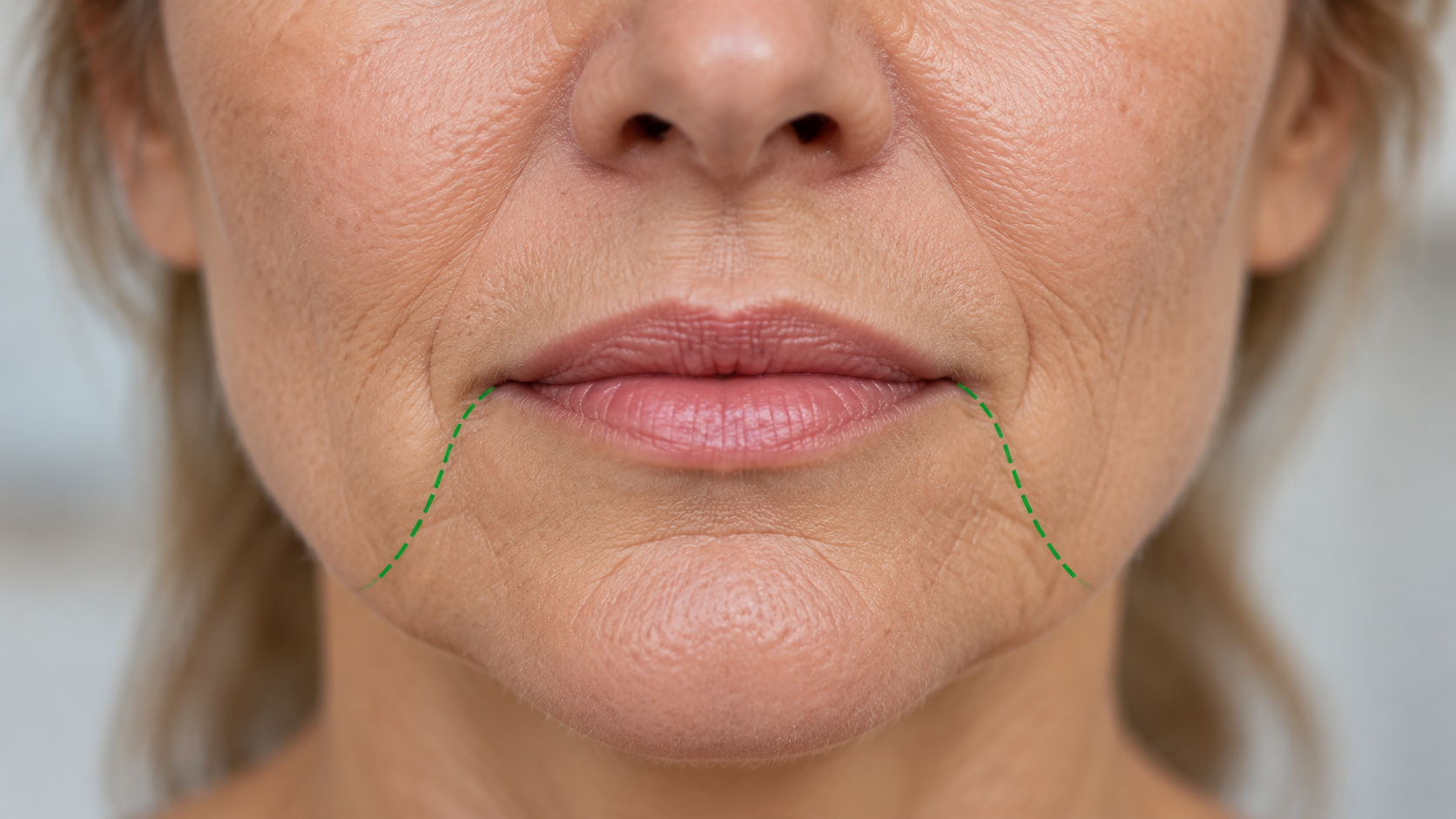
Cleveland Clinic describes marionette lines, also called melomental folds, as creases that extend from the corners of the mouth to the chin. The main driver is age. Skin gradually loses collagen and elastin, the proteins that keep it firm and springy, so it starts to fold where it used to hold its shape.
Other factors speed the process up. Genetics plays a part, so if a parent developed deep lines early, you may too. Sun exposure breaks down collagen faster. Smoking, frequent lip pursing and ongoing stress are also listed as contributors.
There’s a muscle involved as well. The depressor anguli oris, usually shortened to DAO, sits below each corner of the mouth and pulls it downward. Over time that pull can make the mouth look turned down even at rest, which deepens the shadow of the line.
Can filler fix marionette lines?
Filler can soften marionette lines a great deal, especially when the fold is caused by lost volume. Hyaluronic acid filler is a gel that adds structure under the crease and lifts the skin back toward where it used to sit. The change is visible right away.
But filler works best when the injector looks beyond the line. A deep marionette fold often reflects volume loss higher up in the face, in the cheeks and along the jaw. Placing all the product directly into the crease can look heavy. Supporting the areas around it tends to look more natural, which is why a good filler treatment plan often includes more than one area.
Results are temporary. Cleveland Clinic notes that these cosmetic treatments wear off over time and need repeat sessions to maintain.
What is the best filler for marionette lines?
There isn’t one best product for everyone. The right choice depends on how deep the lines are, how much the area moves when you talk and smile, and the quality of the skin around it. The mouth area is highly mobile, so injectors often favour a softer, flexible hyaluronic acid filler here and reserve firmer products for deeper structural support along the jaw.
For a closer look at how products differ between the lower face, lips and under-eyes, see our guide on which type of dermal filler is best for marionette lines, lips and tear troughs.
Can Sculptra or Radiesse help marionette lines?
Yes, though they work differently from filler. Sculptra and Radiesse are known as biostimulators. Instead of filling a fold directly, they encourage your skin to build more of its own collagen over time.
Cleveland Clinic explains that Sculptra is made of poly-L-lactic acid, which absorbs into the body a few days after treatment and prompts cells to produce more collagen. Skin starts to look fuller within about a month, and results can last more than two years. It usually takes a series of sessions to build up.
For marionette lines, a biostimulator is most useful when the lines are part of wider laxity: skin along the lower cheeks and jaw that has thinned and started to sag. It improves the skin that the line sits in. Many people pair it with a small amount of hyaluronic acid filler for a more immediate softening. Learn more about Sculptra and Radiesse in London, Ontario.
Does Botox help marionette lines?
Botox doesn’t fill marionette lines. It can help with one part of the problem, though. A precise, small dose into the DAO muscle relaxes its downward pull, so the corners of the mouth sit a little higher at rest.
The evidence is encouraging but still limited. In a 2024 ultrasound study of 41 patients published in the Aesthetic Surgery Journal, Zhang and colleagues reported an 88.3 percent improvement in mouth corner drooping at neutral expression after ultrasound-guided injections, with 97.5 percent patient satisfaction at three months. That’s a small study, and placement matters. The same research notes that asymmetrical smiles are a known risk when injections land in the wrong spot, which is why this area calls for an experienced injector.
Results in the mouth area are shorter-lived than in the forehead. Goldman and Wollina, writing in the Journal of Cutaneous and Aesthetic Surgery, reported effects lasting around three months in the oral region. You can read more about cosmetic Botox treatments and how they’re planned.
Why a combined plan works best
Because marionette lines have several causes, a single product usually can’t address all of them. A typical plan might combine filler for the fold, a biostimulator for skin support and a small dose of Botox for the mouth corners. Not everyone needs all three. Some people only need one.
Skin quality counts too. Cleveland Clinic also lists chemical peels, microneedling and laser resurfacing among the options for marionette lines, and for very deep folds with significant sagging, surgical options such as a facelift may be more appropriate than injectables. An honest assessment should tell you that.
Daily sunscreen protects whatever results you get. Sun exposure is one of the causes of collagen loss in the first place.
What to expect at a consultation in London, Ontario
A consultation should start with an assessment of your whole lower face, not just the lines. Expect your injector to look at you from the front and side, at rest and while you talk and smile, and to ask about your medical history, medications and any previous injectables.
From there, you should get a clear explanation of which option fits your face, how many sessions it may take, what recovery looks like and what results are realistic. Common side effects of injectables include swelling, bruising and tenderness at the injection site, which usually settle within a few days. If you’d like an assessment, you can book a consultation at Infinite Medical Spa.
Frequently asked questions
Can you get rid of marionette lines completely?
Treatment can soften them significantly, but no option erases them for good. Cleveland Clinic notes that marionette lines naturally occur with age and that cosmetic treatments are temporary, so maintenance sessions are part of keeping results.
How long does marionette line treatment last?
It depends on what’s used. Hyaluronic acid filler is temporary and varies by product and by how much the area moves. Cleveland Clinic states that Sculptra can last more than two years. Botox in the mouth area lasts around three months, according to Goldman and Wollina.
How much does it cost to treat marionette lines?
Cost depends on the products used, how many syringes or vials you need and how many sessions it takes. For collagen stimulators, our Sculptra cost guide for London, Ontario walks through what affects the price.
Can marionette lines be prevented?
Not entirely. Cleveland Clinic recommends sunscreen, staying hydrated, good sleep, not smoking, managing stress and a consistent skincare routine to help slow them down.
What are the side effects of Sculptra?
Cleveland Clinic lists swelling, bruising, discolouration, discomfort, itching, and small bumps or lumps under the skin as possible side effects. Bruising and swelling at the injection site usually go away within a couple of days.
Sources
- Cleveland Clinic. Marionette Lines: What They Are, Causes, Filler and Treatments.
- Cleveland Clinic. Sculptra: What It Is, Where It’s Injected, Results and Risks.
- American Society of Plastic Surgeons. 2024 Procedural Statistics press release (2025).
- Zhang et al. Deciphering Depressor Anguli Oris for Lower Face Rejuvenation: A Prospective Ultrasound-based Investigation. Aesthetic Surgery Journal, 2024.
- Goldman A, Wollina U. Elevation of the Corner of the Mouth Using Botulinum Toxin Type A. Journal of Cutaneous and Aesthetic Surgery.
This article was medically reviewed by Derek Truong, NP, Medical Director at Infinite Medical Spa. It is for general education only and is not a substitute for an individual medical assessment. Results vary from person to person.