
CoolPeel CO2 Laser for $649 | Save $150+ | Ends Nov 30
Low-Downtime CO2 Laser (CoolPeel) | London Ontario | Infinite Medical Spa Offer ends in (519) 709-6494 Book NowBook CoolPeel CO2 Results Recovery Pricing Reviews FAQ
Medically reviewed by Derek Truong, NP, Medical Director at Infinite Medical Spa.
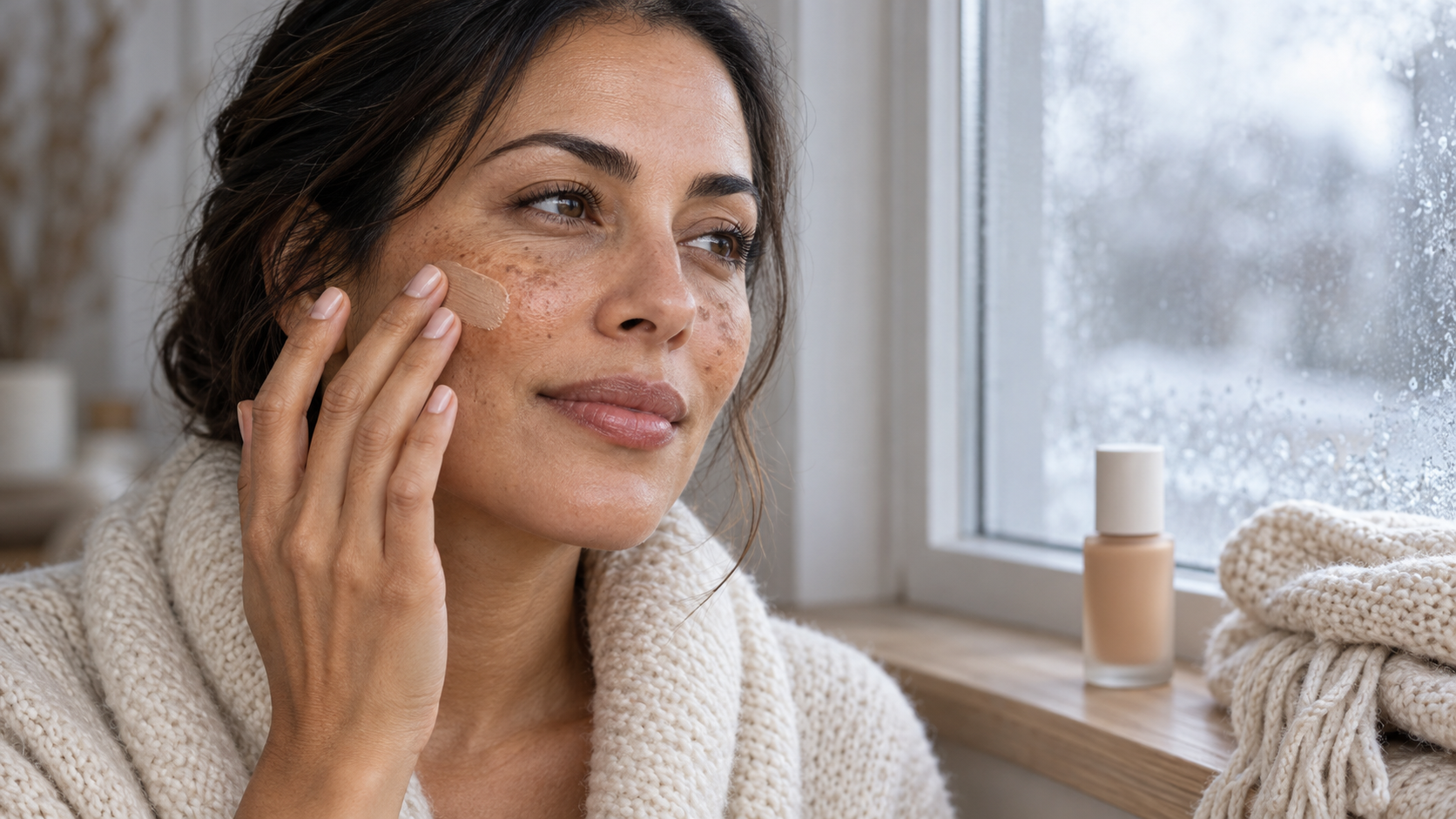
Melasma treatment in London, Ontario works best when it starts in the cooler months, pairs daily tinted sunscreen with gentle in-clinic care, and steers clear of high-heat treatments that can leave the patches darker. Melasma is a stubborn, recurring type of facial pigmentation, and it shows up far more often in women. About 90% of people with melasma are women, and 15% to 50% of pregnant women develop it, according to Cleveland Clinic (2020).
Because melasma tends to fade in winter and darken in summer, late fall gives treatment the longest runway. If you’re still sorting out which brown patches are which, our guide explaining what hyperpigmentation is and why it forms covers the wider family melasma belongs to. This article stays on melasma itself: what sets it off, which treatments can backfire, and what a realistic plan looks like here in London, ON.
Melasma causes flat, light-brown to grey-brown patches that usually appear on both cheeks, the forehead, the bridge of the nose and above the upper lip (Cleveland Clinic, 2020). It’s rarely seen before puberty and is most common in women of reproductive age, according to a review in Canadian Family Physician (2005).
Sun spots look different. They tend to be smaller, rounder and scattered. Melasma spreads in broader, blotchy shapes that often mirror each other on each side of the face.
Depth matters too. Pigment can sit in the top layer of skin (epidermal), deeper in the dermis (dermal), or in both (mixed). Mixed melasma is the most common type, and the deeper the pigment sits, the slower it tends to respond (Cleveland Clinic, 2020).
That’s why an assessment comes before any treatment. Every first visit at Infinite Medical Spa includes a complimentary VISIA skin analysis that photographs your skin and maps where your pigment sits, which helps your provider match the treatment to your skin. Melasma can look like several other skin conditions, so anything unusual gets referred to a physician to confirm.
Melasma typically lightens in winter and darkens in summer (Cleveland Clinic, 2020). Treated skin stays more sensitive to light for a while, and London, Ontario’s short, grey winter days make it much easier to protect.
Results are also slow. The American Academy of Dermatology (AAD, 2022) notes that melasma usually takes 3 to 12 months to show results, even when the plan is followed closely. Starting in October or November means most of that work happens before late spring, when longer days and stronger sun would normally pull the patches back out.
Winter doesn’t mean sunscreen goes in a drawer, though. Light still reaches your face through windows and on your commute, and some of the most common triggers have nothing to do with the sun.
Two things drive most melasma: light and hormones (Cleveland Clinic, 2020). Light here means more than ultraviolet rays. Visible light and infrared heat both play a part, which is why some people flare from things that would never give them a sunburn.
Common triggers include:
When a trigger like pregnancy or a medication goes away, melasma sometimes fades on its own (AAD, 2022). When it doesn’t, treatment helps most when those triggers are managed alongside it.
Yes, the wrong one can. Melasma skin is easily irritated, and inflammation tells pigment cells to make more pigment. High-heat lasers and aggressive resurfacing can leave melasma darker than it started, a reaction called rebound hyperpigmentation.
Even gentler lasers carry that risk when settings are pushed too hard. A 2022 systematic review of low-fluence Q-switched Nd:YAG laser for melasma found that rebound darkening and patchy light spots were rare, but showed up more often in darker skin types, Fitzpatrick IV and V (Medicina, 2022). Settings and provider experience matter as much as the device.
IPL is a good example of a treatment that suits one kind of pigment and not another. It’s a strong choice for sun spots, freckles and redness, but its broad-spectrum light builds heat in the skin, so an IPL photofacial is usually saved for sun damage and redness rather than melasma.
There’s no single best treatment for melasma (AAD, 2022). The plans that work usually layer a few approaches together.
This is the foundation, and it does more than most people expect. In a 2014 randomized trial of 68 melasma patients, those using an SPF 50 sunscreen with iron oxide improved more than those using a standard UV-only SPF 50, with both groups also using a brightening cream (Castanedo-Cazares et al., 2014). A 2026 literature review reported a similar pattern, with melasma severity scores dropping 75% with UV plus visible light protection versus 60% with UV-only sunscreen (Journal of Drugs in Dermatology, 2026). Look for a mineral sunscreen with zinc oxide and iron oxides, usually sold as tinted.
Topical ingredients that slow pigment production are usually the first step. Options include azelaic acid, kojic acid and vitamin C, along with prescription creams like hydroquinone or a triple combination cream (AAD, 2022). For stubborn cases, a prescriber may consider tranexamic acid, applied to the skin or taken as a pill. It isn’t suitable for everyone, particularly anyone with a history of blood clots (AAD, 2022).
A peel removes pigment-heavy surface cells and speeds up skin renewal, and the AAD (2022) lists it as a way to improve results when skincare alone stalls. At Infinite, the Perfect Derma Peel is a medium-depth peel with kojic acid and glutathione that’s used on all skin tones. That matters for melasma, which is more common in people who tan easily or have deeper skin tones (Cleveland Clinic, 2020).
For pigment that sits deeper, a Q-switched laser can break pigment into tiny fragments the body clears over the following weeks. Low-fluence Q-switched Nd:YAG has become a widely used approach for melasma, especially in Asia (Medicina, 2022). The AAD (2022) notes that adding a laser can improve results for people already using sun protection and skincare, so the laser works as an add-on rather than a replacement.
The right plan depends on how deep your pigment sits, your skin tone, and what’s setting it off. A simple way to think about it:
For that middle group, Infinite Medical Spa uses the DEKA Toro. Its 1064nm wavelength reaches deeper pigment with very little surface heat, and it’s used across skin tones, including Fitzpatrick IV to VI. Before booking, you can see how a Toro deep pigment laser session works, from VISIA mapping to the darkening phase. Most melasma needs a series of sessions spaced several weeks apart, with daily sun protection in between.
Melasma treatment is paid out of pocket. It isn’t considered medically necessary, so most insurers don’t cover it (AAD, 2022). Across Canada, typical market ranges look like this, according to a December 2025 iFinance Canada guide:
Full treatment plans often land between $1,000 and $3,000, depending on depth and the number of sessions (iFinance Canada, 2025). These are Canadian market ranges, not Infinite Medical Spa’s prices. Our breakdown of what drives skin pigmentation treatment costs in Canada explains why two quotes can look so different, and a consultation is the only way to get a number that fits your skin.
Infinite Medical Spa, London, Ontario
Every new patient at Infinite starts with a complimentary VISIA skin analysis and a treatment plan mapped by our team under Derek Truong, NP, Medical Director. You leave knowing how deep your pigment sits and which melasma treatment fits it, with no obligation to book treatment.
551 Oxford St W, Unit 201 · (519) 709-6494 · Mon to Sat, 8 to 4
Sometimes. Melasma linked to pregnancy or a medication often fades once that trigger is gone, usually over about three months (Cleveland Clinic, 2020; AAD, 2022). Melasma without a clear trigger can last for years.
Melasma is a chronic condition, so it’s managed rather than cured. It can improve a lot with treatment, but it tends to come back without steady sun protection (Cleveland Clinic, 2020).
Yes. About 10% of people with melasma are men (Cleveland Clinic, 2020). Treatment works the same way.
Most people see results within 3 to 12 months, and longstanding melasma can take longer (AAD, 2022).
It does. In a 2025 randomized study, people with melasma who wore a high-protection sunscreen every day through the summer kept their melasma stable, and some saw it lighten (Polena et al., 2025). Tinted formulas with iron oxides add protection from visible light.
Many cases fade after delivery, so most treatment waits until then. During pregnancy, stick to sun protection and products approved for use in pregnancy, and check with your provider first (Cleveland Clinic, 2020).
This article was medically reviewed by Derek Truong, NP, Medical Director at Infinite Medical Spa in London, Ontario. It is for general education only and is not a substitute for an individual assessment.

Derek Truong, NP — Medical Director, Infinite Medical Spa
Derek Truong is a Nurse Practitioner and the Medical Director at Infinite Medical Spa in London, Ontario. He sets our clinical standards and medically reviews our educational content for accuracy and safety. Learn more about our team.
Low-Downtime CO2 Laser (CoolPeel) | London Ontario | Infinite Medical Spa Offer ends in (519) 709-6494 Book NowBook CoolPeel CO2 Results Recovery Pricing Reviews FAQ
Why Does My Skin Look Dull? What Actually Brings Back Radiance in London, Ontario Medically reviewed by Derek Truong, NP, Medical Director at Infinite Medical
Can You Actually Shrink Your Pores? The Skincare and Treatments That Work in London, Ontario Medically reviewed by Derek Truong, NP, Medical Director at Infinite
