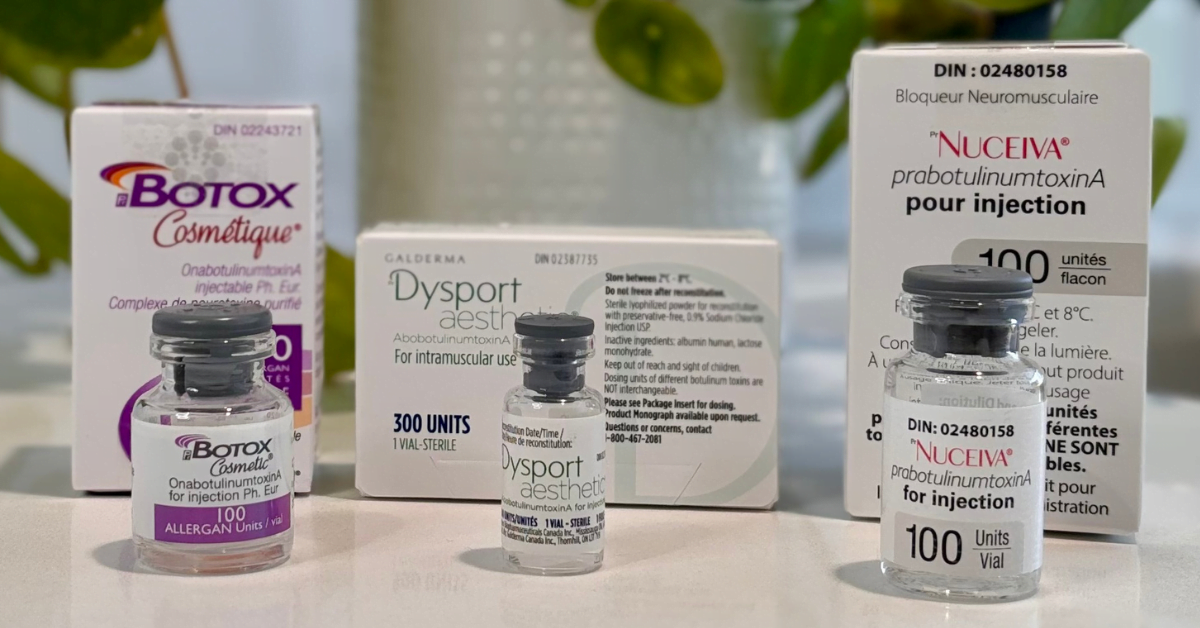
If you’ve looked into smoothing out fine lines, you’ve run into the big four: Botox, Dysport, Xeomin, and Jeuveau. They sound like competitors, and in a way they are, but they’re more alike than most people realize. The most common question we hear is Dysport vs Botox, though all four are worth understanding before you book. Here’s the plain-language version.
Here’s the thing they share. Every one of these is made from botulinum toxin type A, and they all work the same basic way: by relaxing the specific muscles that crease your skin when you frown, squint, or raise your brows. Soften those movements and the lines soften too. Where they differ is in the formulation, and that’s where the practical differences come from.
Dysport vs Botox vs Xeomin vs Jeuveau: The Quick Version
All four treat dynamic wrinkles, the ones caused by muscle movement rather than sun damage or volume loss. They’re quick to inject, minimally invasive, and temporary. What separates them is how the product spreads, how fast it kicks in, and what’s mixed in with the toxin. None is universally “best.” The right one depends on the area being treated and how your body responds.
The original and the name everyone knows. Health Canada approved Botox for cosmetic use back in 2002, so it has the longest track record of the group. It’s prized for precision, which is why injectors reach for it on delicate areas like crow’s feet, forehead lines, and the frown lines between your brows. If you want a treatment with decades of data behind it, this is it. Curious how long results hold? We break that down in our guide to how long Botox lasts.
Dysport
Introduced in Canada in 2009, Dysport is known for spreading a little more than Botox once it’s injected. That diffusion makes it well suited to larger areas like the forehead, where you want smooth, even coverage rather than pinpoint targeting. Some people also find Dysport kicks in faster, sometimes within two to three days. Whether it lasts longer than Botox varies person to person.
Xeomin
Xeomin arrived in 2010 with a twist: it’s a “naked” toxin. In plain terms, Xeomin is stripped of the surrounding proteins the others carry. The theory is that with fewer added proteins, your body is less likely to build up resistance over time, which can matter for people who get treated regularly. It handles the same dynamic wrinkles as the rest.
Jeuveau
The newcomer, approved in 2019. Jeuveau is sometimes called the “millennial Botox” because it was developed specifically for aesthetic use. It targets the same frown lines and forehead creases, and it’s earned a loyal following fast. Some injectors and clients simply prefer how it performs for them.
Which One Is Right for You?
Honestly, there’s no single winner, and any injector who tells you otherwise is selling something. The best choice depends on the area you’re treating, how quickly you want to see results, whether you’ve built resistance to a product before, and how your muscles respond. An experienced injector often has a feel for which one suits a particular face and goal.
Results also vary from person to person, so the smart move is a conversation, not a guess. We offer these wrinkle-relaxing treatments here at Infinite Medical Spa in London, Ontario, and we’ll walk you through which fits your goals and budget. Wondering about pricing first? Our guide to Botox cost in Canada is a good place to start. When you’re ready, book a consultation and we’ll sort out the rest together.
FAQs
Is Dysport better than Botox?
Neither is better across the board. Dysport spreads more, which suits larger areas like the forehead and may act a bit faster, while Botox offers precise targeting for smaller zones. The right pick depends on your face and goals.
Are Botox, Dysport, Xeomin, and Jeuveau all the same thing?
They’re all botulinum toxin type A and work the same basic way, but their formulations differ. Those differences affect how each spreads, how quickly it works, and how your body may respond over time.
How long do these treatments last?
Most people see results for about three to four months, though it varies by product, dose, and individual. Regular treatment is what maintains the effect.
Which treatment is best for first-timers?
There’s no one answer. A consultation with a qualified injector is the best way to match the product to your goals, especially if it’s your first time. Your injector will factor in the area, your muscle strength, and what you want to achieve.